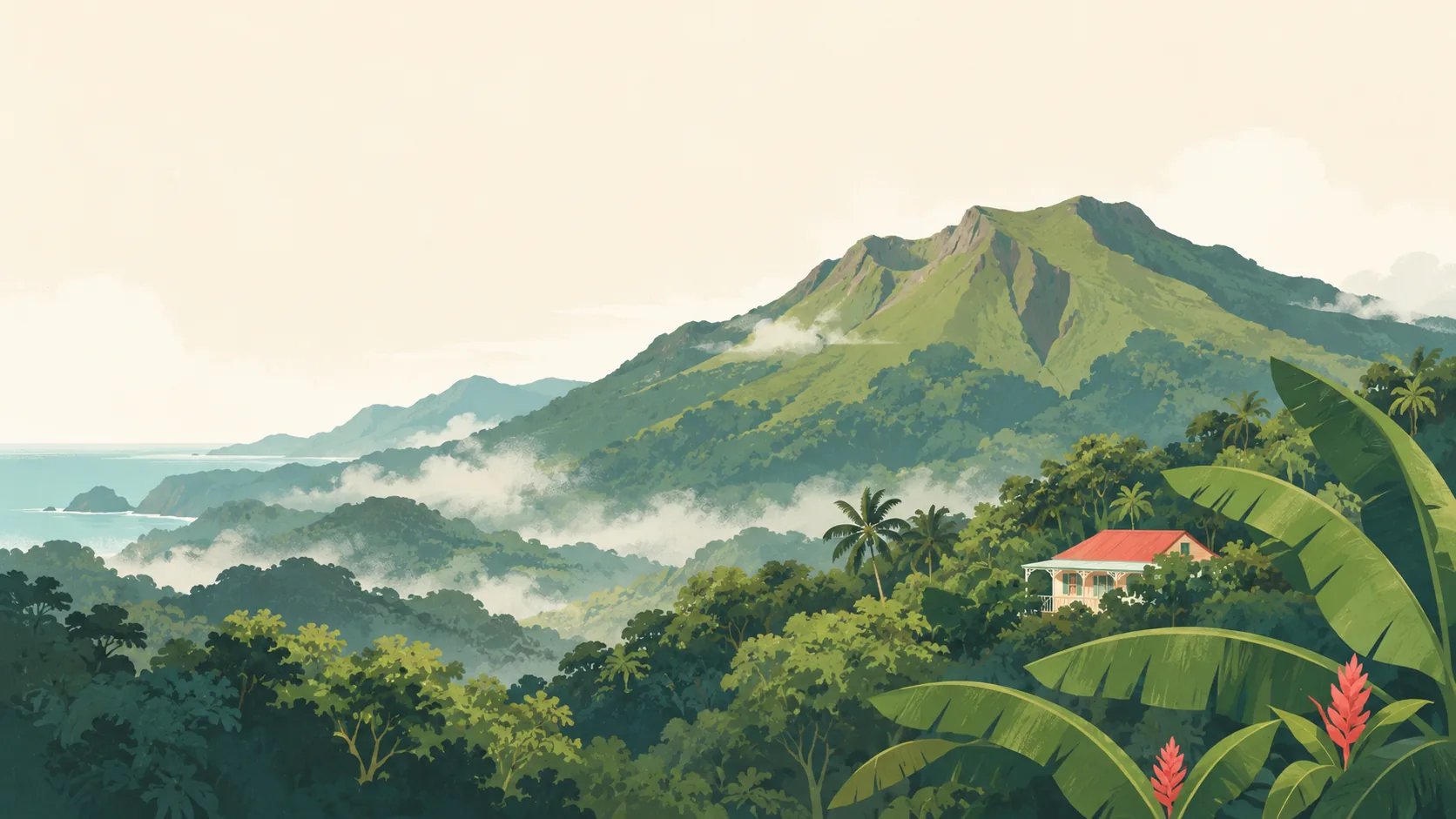


Basse-Terre: what to expect
Use current park and volcanic guidance; wet mountain routes need flexible days. This travel base guide groups the destination into six useful areas so the stay works on the ground, not only on a country map.
Is this your trip?
Who Basse-Terre is for
Heritage travellers
Use current park and volcanic guidance; wet mountain routes need flexible days.
Travellers with 2–3 days
That window gives Basse-Terre enough room for one anchor area and one contrasting cluster per day.
Mountain gateway
Saint-Claude and La Soufrière routes make that interest practical rather than a country-level promise.
Area-led planners
Six fixed clusters make it easier to choose a base and avoid repeated cross-destination transfers.
Maybe not for you: A compressed checklist is the weak version of Basse-Terre. Check current access, local permissions and the return connection; keep remote or weather-sensitive transport away from the international departure day.
Season by season
When to visit Basse-Terre
November–February. Rounded tropical-monsoon planning normals: hot year-round, with a pronounced wet season. Conditions can still change sharply by elevation, coast and exposure, so use the chart for route timing and the current forecast for the day itself.
- Best
Cooler dry
November–February
Lower humidity and rain make this the easiest period, also the busiest.
- Mixed
Hot season
March–May
Very hot afternoons reward early starts, shade and a slower pace.
- Good
Wet season
June–October
Short intense rain and occasional disruption come with greener landscapes and value.
- Mixed
Peak rain
August–September
Build weather margin into road, boat and outdoor days.
Weather · monthly normals
Rounded tropical-monsoon planning normals: hot year-round, with a pronounced wet season. Values are rounded planning normals rather than a live forecast.
Do fewer things better
Things to do in Basse-Terre
A short, ordered set of experiences with the timing or planning catch that makes each one work.
- 1
Start with Basse-Terre town
Basse-Terre town
Basse-Terre town is a useful cluster for heritage, with enough substance for an unhurried half-day.
- 2
Walk Saint-Claude without stacking it
Saint-Claude
Saint-Claude is a useful cluster for mountain gateway, with enough substance for an unhurried half-day.
- 3
Use La Soufrière routes for current safety
La Soufrière routes
Arrange this part of the visit with local hosts or the responsible operator, who can confirm permission and current access.
- 4
Give Deshaies a deliberate half-day
Deshaies
Deshaies is a useful cluster for coastal base, with enough substance for an unhurried half-day.
- 5
See Bouillante outside peak hours
Bouillante
Bouillante is a useful cluster for marine activities, with enough substance for an unhurried half-day.
- 6
Keep Carbet Falls area weather-flexible
Carbet Falls area
Arrange this part of the visit with local hosts or the responsible operator, who can confirm permission and current access.
Check current access, local permissions and the return connection; keep remote or weather-sensitive transport away from the international departure day.
Area by area
The areas of Basse-Terre
A real map at local-city scale: enough geography to choose a base, compare areas and group a day. Numbered places match the notes below.
| Area | What it is like | Why go |
|---|---|---|
1 Basse-Terre town heritage | Basse-Terre town is a useful cluster for heritage, with enough substance for an unhurried half-day. | Use Basse-Terre town when heritage matters more than crossing the whole destination. |
2 Saint-Claude mountain gateway | Saint-Claude is a useful cluster for mountain gateway, with enough substance for an unhurried half-day. | Use Saint-Claude when mountain gateway matters more than crossing the whole destination. |
3 La Soufrière routes current safety | Arrange this part of the visit with local hosts or the responsible operator, who can confirm permission and current access. | Use La Soufrière routes when current safety matters more than crossing the whole destination. |
4 Deshaies coastal base | Deshaies is a useful cluster for coastal base, with enough substance for an unhurried half-day. | Use Deshaies when coastal base matters more than crossing the whole destination. |
5 Bouillante marine activities | Bouillante is a useful cluster for marine activities, with enough substance for an unhurried half-day. | Use Bouillante when marine activities matters more than crossing the whole destination. |
6 Carbet Falls area authorised walking | Arrange this part of the visit with local hosts or the responsible operator, who can confirm permission and current access. | Use Carbet Falls area when authorised walking matters more than crossing the whole destination. |
Choose the base, then the hotel
Where to stay in Basse-Terre
For most first visits: Basse-Terre town for heritage.
Basse-Terre town
Basse-Terre town is a useful cluster for heritage, with enough substance for an unhurried half-day. Choose it when that trade-off should shape mornings and evenings.
Saint-Claude
Saint-Claude is a useful cluster for mountain gateway, with enough substance for an unhurried half-day. Choose it when that trade-off should shape mornings and evenings.
La Soufrière routes
Arrange this part of the visit with local hosts or the responsible operator, who can confirm permission and current access. Choose it when that trade-off should shape mornings and evenings.
Deshaies
Deshaies is a useful cluster for coastal base, with enough substance for an unhurried half-day. Choose it when that trade-off should shape mornings and evenings.
Order with a point of view
What to eat in Basse-Terre
Local food is more useful as an area decision than as a checklist of famous dishes.
- 01
Accras
Basse-Terre town
Fritters are a familiar Creole snack.
- 02
Colombo
Saint-Claude
Spiced stews reflect the islands’ culinary connections.
- 03
Bokit
La Soufrière routes
A filled fried-bread sandwich is a local favourite.
- 04
Court-bouillon fish
Deshaies
Local fish preparations vary by kitchen.
- 05
Tourment d’amour
Bouillante
The filled cake is associated with Les Saintes.
Useful on the ground
Local tips for Basse-Terre
Plan the transfer, not only the distance
Check current access, local permissions and the return connection; keep remote or weather-sensitive transport away from the international departure day.
Check entry before buying flights
Check the French overseas entry rules specifically for Guadeloupe. A mainland Schengen visa is not automatically sufficient; confirm the passport-specific rule and any transit permissions.
Euro and payments
Euro is used. Confirm card and ATM access, the currency of quoted prices and suitable cash before remote or smaller-island stays.
Coverage and offline planning
Download maps, booking details and essential contacts before leaving Wi-Fi. Check roaming charges and local SIM registration requirements; remote routes may have no signal.
Check socket type and voltage
Confirm the accommodation’s electricity supply and bring an appropriate adapter; remote stays may have limited charging.
Common questions
Quick answers about Basse-Terre
- When is the best time to visit Basse-Terre?
- November–February. Rounded tropical-monsoon planning normals: hot year-round, with a pronounced wet season. Conditions can still change sharply by elevation, coast and exposure, so use the chart for route timing and the current forecast for the day itself.
- How many days do you need in Basse-Terre?
- 2–3 days. Use current park and volcanic guidance; wet mountain routes need flexible days. This travel base guide groups the destination into six useful areas so the stay works on the ground, not only on a country map.
- Where should you stay in Basse-Terre?
- Basse-Terre town for heritage. Basse-Terre town is a useful cluster for heritage, with enough substance for an unhurried half-day. Choose it when that trade-off should shape mornings and evenings.
Keep building the route
Basse-Terre is part of Guadeloupe
Use the country guide for visa, money, long-distance transport and the route between cities. Then compare the other worked-out stops below.