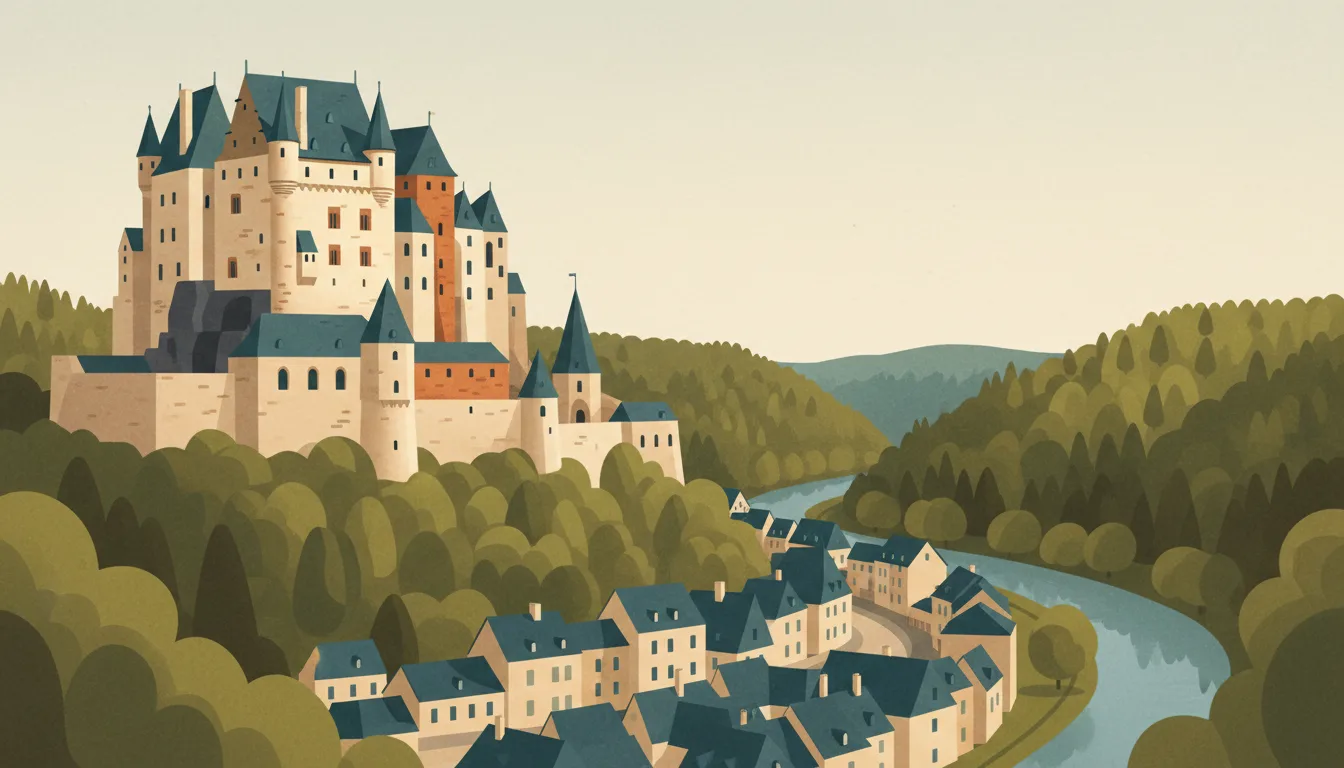


Luxembourg City: what to expect
Walk the Chemin de la Corniche, descend to the Grund and Clausen, tour the Bock casemates, then cross to Kirchberg for the Mudam and Philharmonie. Museums and the Grand Ducal Palace deserve more than a lunch stop. This city guide groups the destination into six useful areas so the stay works on the ground, not only on a country map.
Is this your trip?
Who Luxembourg City is for
First-timers travellers
Walk the Chemin de la Corniche, descend to the Grund and Clausen, tour the Bock casemates, then cross to Kirchberg for the Mudam and Philharmonie. Museums and the Grand Ducal Palace deserve more than a lunch stop.
Travellers with 2–3 days
That window gives Luxembourg City enough room for one anchor area and one contrasting cluster per day.
Riverside evenings and the abbey
Grund and Clausen & Pfaffenthal make that interest practical rather than a country-level promise.
Area-led planners
Six fixed clusters make it easier to choose a base and avoid repeated cross-destination transfers.
Maybe not for you: A compressed checklist is the weak version of Luxembourg City. Treat the suggested stay as time on the ground: weather, timed entry, ferries or mountain roads can remove half a day.
Season by season
When to visit Luxembourg City
May–September. Rounded oceanic planning normals: modest temperature swings and rain possible in every month. Conditions can still change sharply by elevation, coast and exposure, so use the chart for route timing and the current forecast for the day itself.
- Good
Spring
March–May
Longer days and fresh landscapes, with changeable rain and cool evenings.
- Best
Summer
June–August
The warmest and longest days; book popular weekends and outdoor bases early.
- Good
Autumn
September–November
Good early colour and fewer visitors before wetter, shorter days settle in.
- Mixed
Winter
December–February
Cool, damp and dark, although cities retain strong indoor culture.
Weather · monthly normals
Rounded oceanic planning normals: modest temperature swings and rain possible in every month. Values are rounded planning normals rather than a live forecast.
Do fewer things better
Things to do in Luxembourg City
A short, ordered set of experiences with the timing or planning catch that makes each one work.
- 1
Start with Ville Haute
Ville Haute
Old town plateau with the palace, cathedral and Bock casemates
- 2
Walk Grund without stacking it
Grund
Lower town on the Alzette reached by the free lift or steps
- 3
Use Clausen & Pfaffenthal for breweries and quiet stays
Clausen & Pfaffenthal
Former brewing quarter beneath the Kirchberg viaducts
- 4
Give Kirchberg a deliberate half-day
Kirchberg
Mudam, Philharmonie and the European quarter on the plateau
- 5
See Gare & Bonnevoie outside peak hours
Gare & Bonnevoie
Station district with the tram, cheaper hotels and diverse restaurants
- 6
Keep Limpertsberg & Belair weather-flexible
Limpertsberg & Belair
Leafy districts around the university site and the fairground
Treat the suggested stay as time on the ground: weather, timed entry, ferries or mountain roads can remove half a day.
Area by area
The neighbourhoods of Luxembourg City
A real map at local-city scale: enough geography to choose a base, compare areas and group a day. Numbered places match the notes below.
| Area | What it is like | Why go |
|---|---|---|
1 Ville Haute first history and the Corniche | Old town plateau with the palace, cathedral and Bock casemates | Use Ville Haute when first history and the Corniche matters more than crossing the whole destination. |
2 Grund riverside evenings and the abbey | Lower town on the Alzette reached by the free lift or steps | Use Grund when riverside evenings and the abbey matters more than crossing the whole destination. |
3 Clausen & Pfaffenthal breweries and quiet stays | Former brewing quarter beneath the Kirchberg viaducts | Use Clausen & Pfaffenthal when breweries and quiet stays matters more than crossing the whole destination. |
4 Kirchberg museums and EU institutions | Mudam, Philharmonie and the European quarter on the plateau | Use Kirchberg when museums and EU institutions matters more than crossing the whole destination. |
5 Gare & Bonnevoie transport and affordable rooms | Station district with the tram, cheaper hotels and diverse restaurants | Use Gare & Bonnevoie when transport and affordable rooms matters more than crossing the whole destination. |
6 Limpertsberg & Belair residential calm and the Glacis | Leafy districts around the university site and the fairground | Use Limpertsberg & Belair when residential calm and the Glacis matters more than crossing the whole destination. |
Choose the base, then the hotel
Where to stay in Luxembourg City
For most first visits: Ville Haute for first history and the Corniche.
Ville Haute
Old town plateau with the palace, cathedral and Bock casemates Choose it when that trade-off should shape mornings and evenings.
Grund
Lower town on the Alzette reached by the free lift or steps Choose it when that trade-off should shape mornings and evenings.
Clausen & Pfaffenthal
Former brewing quarter beneath the Kirchberg viaducts Choose it when that trade-off should shape mornings and evenings.
Kirchberg
Mudam, Philharmonie and the European quarter on the plateau Choose it when that trade-off should shape mornings and evenings.
Order with a point of view
What to eat in Luxembourg City
Local food is more useful as an area decision than as a checklist of famous dishes.
- 01
Judd mat Gaardebounen
Ville Haute
Smoked pork collar with broad beans is the national dish and the benchmark for any traditional brasserie
- 02
Gromperekichelcher
Grund
Fried potato cakes from market and fair stalls are the everyday street food, essential at the Schueberfouer
- 03
Friture de la Moselle
Clausen & Pfaffenthal
Small fried river fish with a glass of Elbling or Rivaner belong to the wine villages, not the capital
- 04
Rieslingspaschtéit
Kirchberg
Veal pâté in pastry with a Riesling jelly shows how wine and charcuterie meet in bakeries
- 05
Crémant de Luxembourg
Gare & Bonnevoie
Sparkling wine from Moselle cooperatives and family cellars is the aperitif to taste at source
Useful on the ground
Local tips for Luxembourg City
Plan the transfer, not only the distance
Treat the suggested stay as time on the ground: weather, timed entry, ferries or mountain roads can remove half a day.
Standard Schengen entry
Luxembourg is an EU and Schengen member; EU and EEA citizens need only ID, and most other visitors use the Schengen visa-waiver or a Schengen visa. Check current EES and ETIAS requirements.
Euro and cards everywhere
Cards and contactless are accepted almost universally; carry a little cash for village cellars and market stalls. ATMs are plentiful and fee-free at most banks.
EU roaming works
EU SIMs roam at home rates; the capital and main towns have strong 5G, while Ardennes valleys and the Müllerthal gorges lose signal on trails.
Type C and F sockets
Standard 230 V European two-pin sockets; UK and North American visitors need an adapter.
Common questions
Quick answers about Luxembourg City
- When is the best time to visit Luxembourg City?
- May–September. Rounded oceanic planning normals: modest temperature swings and rain possible in every month. Conditions can still change sharply by elevation, coast and exposure, so use the chart for route timing and the current forecast for the day itself.
- How many days do you need in Luxembourg City?
- 2–3 days. Walk the Chemin de la Corniche, descend to the Grund and Clausen, tour the Bock casemates, then cross to Kirchberg for the Mudam and Philharmonie. Museums and the Grand Ducal Palace deserve more than a lunch stop. This city guide groups the destination into six useful areas so the stay works on the ground, not only on a country map.
- Where should you stay in Luxembourg City?
- Ville Haute for first history and the Corniche. Old town plateau with the palace, cathedral and Bock casemates Choose it when that trade-off should shape mornings and evenings.
Keep building the route
Luxembourg City is part of Luxembourg
Use the country guide for visa, money, long-distance transport and the route between cities. Then compare the other worked-out stops below.