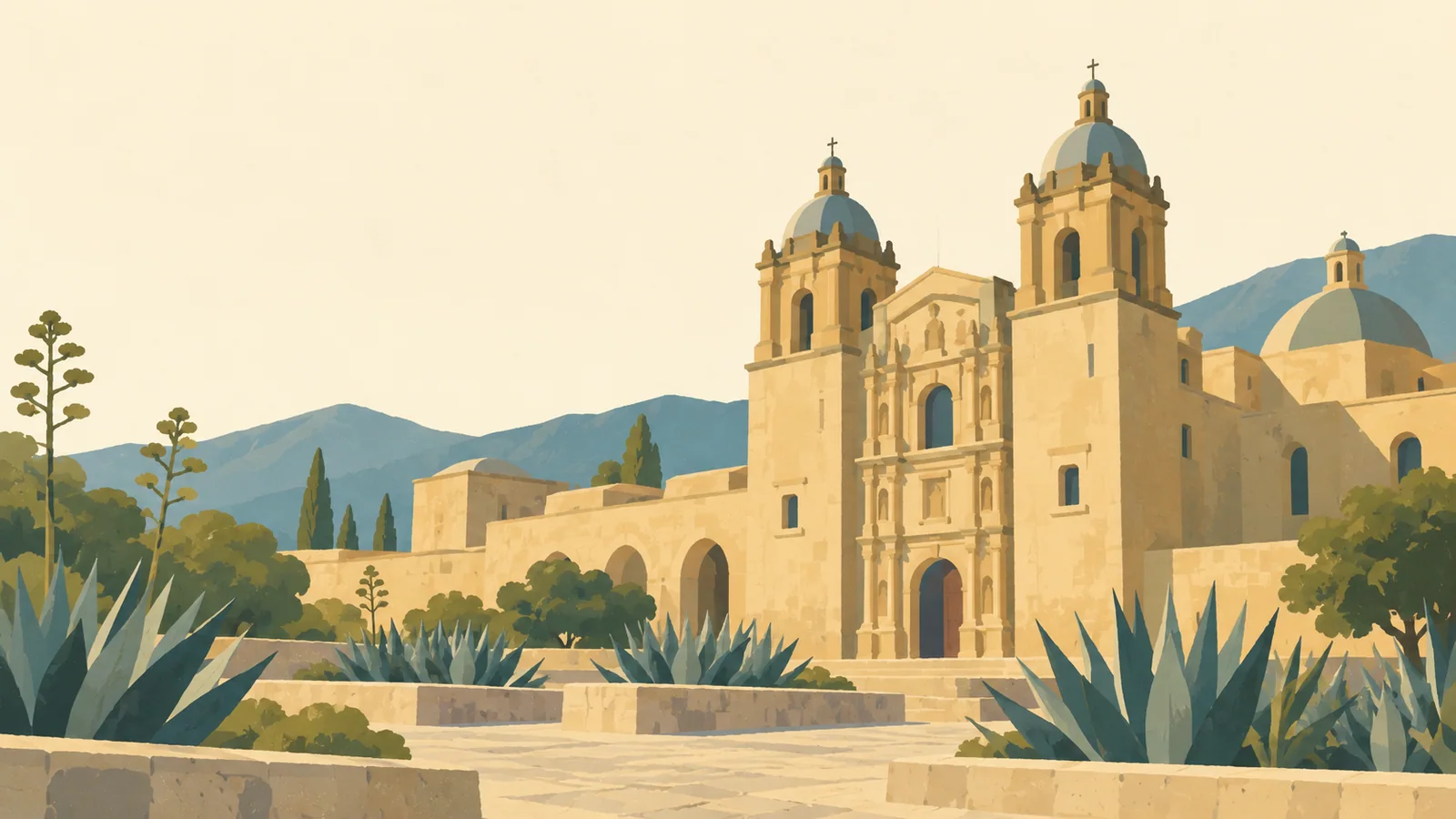


Oaxaca: what to expect
The city is walkable, low, colonial and full of galleries; the valley around it has Monte Albán, the Tlacolula Sunday market, the Hierve el Agua terraces and the mezcal villages. Come for the food — seven moles, tlayudas, chapulines — and the craft villages (Teotitlán del Valle for weaving, San Bartolo Coyotepec for black pottery). Now firmly discovered; it has not yet become expensive. This city guide groups the destination into six useful areas so the stay works on the ground, not only on a country map.
Is this your trip?
Who Oaxaca is for
Food travellers
The city is walkable, low, colonial and full of galleries; the valley around it has Monte Albán, the Tlacolula Sunday market, the Hierve el Agua terraces and the mezcal villages. Come for the food — seven moles, tlayudas, chapulines — and the craft villages (Teotitlán del Valle for weaving, San Bartolo Coyotepec for black pottery). Now firmly discovered; it has not yet become expensive.
Travellers with 3–4 days
That window gives Oaxaca enough room for one anchor area and one contrasting cluster per day.
Colour and quieter stays
Jalatlaco and Xochimilco make that interest practical rather than a country-level promise.
Area-led planners
Six fixed clusters make it easier to choose a base and avoid repeated cross-destination transfers.
Maybe not for you: A compressed checklist is the weak version of Oaxaca. Treat the suggested stay as time on the ground: weather, timed entry, ferries or mountain roads can remove half a day.
Season by season
When to visit Oaxaca
The locally drier season. Rounded tropical-highland planning normals: mild days, cool nights and rainfall shaped more by season than temperature. Conditions can still change sharply by elevation, coast and exposure, so use the chart for route timing and the current forecast for the day itself.
- Best
Drier season
November–April
Clearer mornings and firmer roads suit city walks and highland transfers.
- Good
Early rains
May–June
Green landscapes and afternoon showers still leave useful mornings.
- Mixed
Wet peak
July–October
Cloud, heavy rain and road delays require a less compressed route.
- Good
Transition
October–November
Conditions shift quickly by slope and elevation.
Weather · monthly normals
Rounded tropical-highland planning normals: mild days, cool nights and rainfall shaped more by season than temperature. Values are rounded planning normals rather than a live forecast.
Do fewer things better
Things to do in Oaxaca
A short, ordered set of experiences with the timing or planning catch that makes each one work.
- 1
Start with Centro
Centro
Churches, civic streets and dense food access
- 2
Walk Jalatlaco without stacking it
Jalatlaco
Old eastern barrio with small workshops
- 3
Use Xochimilco for textiles and neighbourhood history
Xochimilco
Northern barrio above the aqueduct
- 4
Give Monte Albán a deliberate half-day
Monte Albán
Major hilltop archaeology west of town
- 5
See Tlacolula Valley outside peak hours
Tlacolula Valley
Sunday trade, craft villages and archaeological sites
- 6
Keep Etla & Sierra Norte weather-flexible
Etla & Sierra Norte
Northern valleys leading to community-run mountain routes
Treat the suggested stay as time on the ground: weather, timed entry, ferries or mountain roads can remove half a day.
Area by area
The neighbourhoods of Oaxaca
A real map at local-city scale: enough geography to choose a base, compare areas and group a day. Numbered places match the notes below.
| Area | What it is like | Why go |
|---|---|---|
1 Centro first architecture and markets | Churches, civic streets and dense food access | Use Centro when first architecture and markets matters more than crossing the whole destination. |
2 Jalatlaco colour and quieter stays | Old eastern barrio with small workshops | Use Jalatlaco when colour and quieter stays matters more than crossing the whole destination. |
3 Xochimilco textiles and neighbourhood history | Northern barrio above the aqueduct | Use Xochimilco when textiles and neighbourhood history matters more than crossing the whole destination. |
4 Monte Albán Zapotec city | Major hilltop archaeology west of town | Use Monte Albán when Zapotec city matters more than crossing the whole destination. |
5 Tlacolula Valley markets and mezcal | Sunday trade, craft villages and archaeological sites | Use Tlacolula Valley when markets and mezcal matters more than crossing the whole destination. |
6 Etla & Sierra Norte food and walking | Northern valleys leading to community-run mountain routes | Use Etla & Sierra Norte when food and walking matters more than crossing the whole destination. |
Choose the base, then the hotel
Where to stay in Oaxaca
For most first visits: Centro for first architecture and markets.
Centro
Churches, civic streets and dense food access Choose it when that trade-off should shape mornings and evenings.
Jalatlaco
Old eastern barrio with small workshops Choose it when that trade-off should shape mornings and evenings.
Xochimilco
Northern barrio above the aqueduct Choose it when that trade-off should shape mornings and evenings.
Monte Albán
Major hilltop archaeology west of town Choose it when that trade-off should shape mornings and evenings.
Order with a point of view
What to eat in Oaxaca
Local food is more useful as an area decision than as a checklist of famous dishes.
- 01
Regional breakfast
Centro
Chilaquiles, tamales and egg dishes change with the local salsa, masa and morning market
- 02
Market fonda lunch
Jalatlaco
A comida corrida gives soup, main and agua fresca without turning lunch into a tasting marathon
- 03
Masa specialist
Xochimilco
Choose tortillas, memelas, sopes or panuchos made for the region and cooked to order
- 04
Regional stew or mole
Monte Albán
Ask which chilli, seed and cooking tradition makes the sauce local
- 05
Fruit, cacao or agave drink
Tlacolula Valley
Taste the non-alcoholic traditions too; provenance matters more than novelty
Useful on the ground
Local tips for Oaxaca
Plan the transfer, not only the distance
Treat the suggested stay as time on the ground: weather, timed entry, ferries or mountain roads can remove half a day.
Visa and entry
EU, UK, US, Canadian and Australian citizens enter visa-free as tourists for up to 180 days. At airports the paper FMM card has been replaced by a passport stamp with the number of days handwritten on it — check it before you leave the desk, since officers sometimes grant fewer than 180. Quintana Roo levies a small state tourism tax (Visitax, about €12) payable online; enforcement is patchy. Keep the airline's outbound proof handy.
Money
Pesos, roughly 20–22 to the euro. Withdraw from bank-branch ATMs (BBVA, Banorte, Santander, HSBC) which charge a flat €1.50–3 fee; avoid stand-alone machines in tourist zones, and always decline the conversion offer. Cards work in cities, chains, ADO and most restaurants; carry 1,000–2,000 pesos in small notes for markets, tips, colectivos and small towns. US dollars are accepted only on the Caribbean coast, at poor rates.
SIM and data
Telcel has by far the best coverage. Buy a Telcel SIM at any OXXO (about €8–10 with several GB) or install an eSIM (Airalo, Holafly, Ubigi) before flying. Coverage is good in cities and along highways, patchy in the Chiapas highlands, the Copper Canyon and the Baja interior. WhatsApp is how the country does business — hotels, guides and restaurants all answer it faster than email.
Plugs and power
Type A and B (US-style flat pins) at 127 V, 60 Hz. European travellers need an adapter; phone and laptop chargers handle the voltage. Older hotels have ungrounded two-pin sockets only, so a plug with an earth pin may not fit.
Common questions
Quick answers about Oaxaca
- When is the best time to visit Oaxaca?
- The locally drier season. Rounded tropical-highland planning normals: mild days, cool nights and rainfall shaped more by season than temperature. Conditions can still change sharply by elevation, coast and exposure, so use the chart for route timing and the current forecast for the day itself.
- How many days do you need in Oaxaca?
- 3–4 days. The city is walkable, low, colonial and full of galleries; the valley around it has Monte Albán, the Tlacolula Sunday market, the Hierve el Agua terraces and the mezcal villages. Come for the food — seven moles, tlayudas, chapulines — and the craft villages (Teotitlán del Valle for weaving, San Bartolo Coyotepec for black pottery). Now firmly discovered; it has not yet become expensive. This city guide groups the destination into six useful areas so the stay works on the ground, not only on a country map.
- Where should you stay in Oaxaca?
- Centro for first architecture and markets. Churches, civic streets and dense food access Choose it when that trade-off should shape mornings and evenings.
Keep building the route
Oaxaca is part of Mexico
Use the country guide for visa, money, long-distance transport and the route between cities. Then compare the other worked-out stops below.
- Mexico CityA 22-million-person capital that rewards patience
- YucatánMérida, Valladolid, Chichén Itzá and a thousand cenotes
- Cancún & the Riviera MayaThe Caribbean strip: US prices, Mexican weather
- Guanajuato & San Miguel de AllendeTwo colonial hill towns, ninety minutes apart
- ChiapasSan Cristóbal, Palenque and the Lacandon jungle
- PueblaTilework, regional cooking and a monumental centre
- MoreliaPink-stone streets and Michoacán food
- QuerétaroPatios, plazas and an inland historic city
- MéridaMaya context, Yucatecan cooking and shaded plazas
- La PazA working Baja city beside a broad bay
- GuadalajaraJalisco culture beyond a single city centre
- CampecheA fortified Gulf port with a compact old town
- AguascalientesRailway heritage and an unhurried inland centre
- San Luis PotosíA highland city of plazas and civic history
- VeracruzGulf port history and waterfront café life