

Fes: what to expect
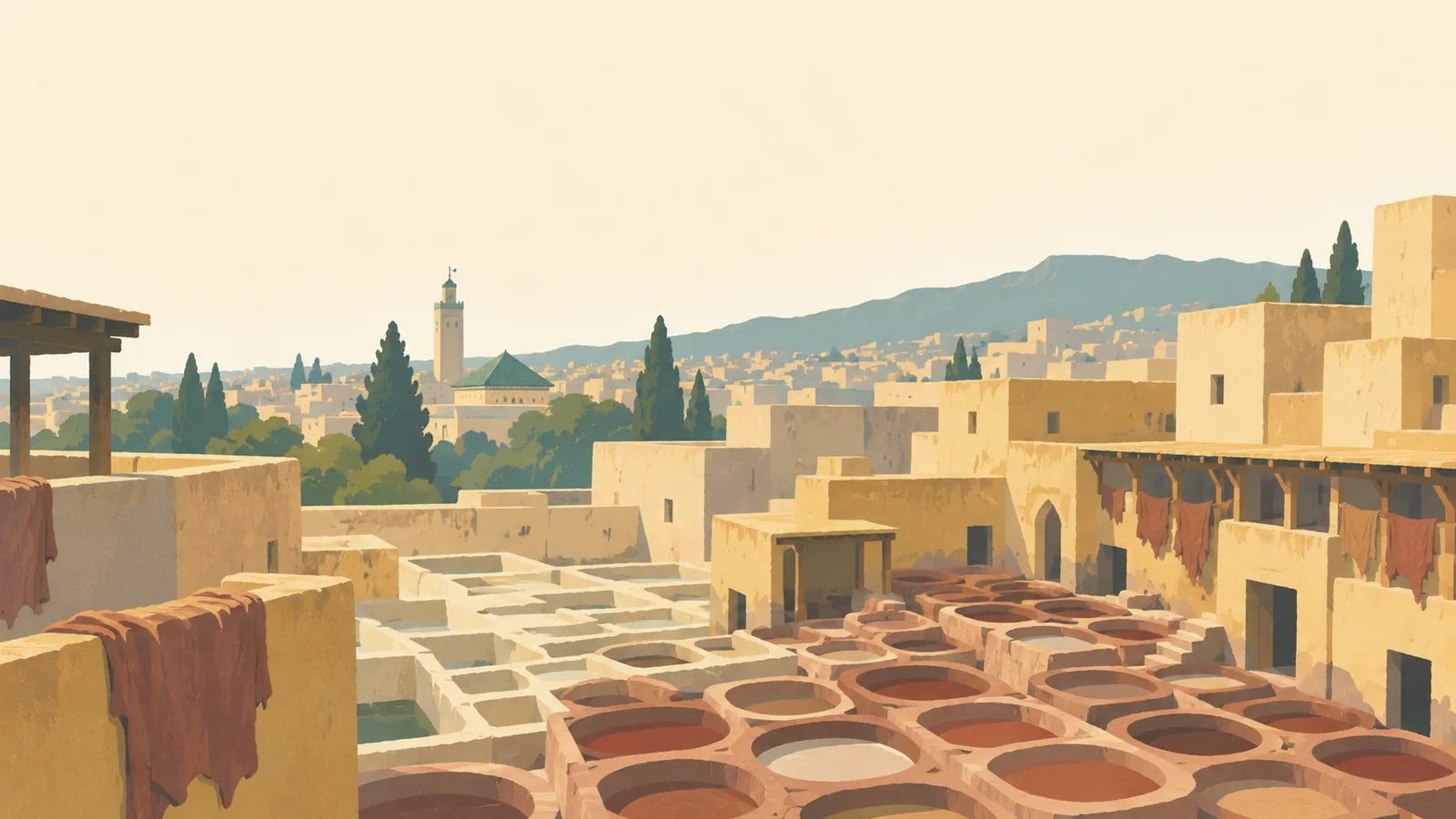
Fes el-Bali is the largest car-free urban area in the world and the most intact medieval city in the Arab world: 9,000 alleys, the Chouara tanneries, the Bou Inania and Attarine medersas, and the Kairaouine university. It is less polished and more genuine than Marrakech. Take a guide for the first half-day (it is not optional, you will get lost), then wander. Meknes and Volubilis are a day trip. This city guide groups the destination into six useful areas so the stay works on the ground, not only on a country map.
Is this your trip?
Who Fes is for
History travellers
Fes el-Bali is the largest car-free urban area in the world and the most intact medieval city in the Arab world: 9,000 alleys, the Chouara tanneries, the Bou Inania and Attarine medersas, and the Kairaouine university. It is less polished and more genuine than Marrakech. Take a guide for the first half-day (it is not optional, you will get lost), then wander. Meknes and Volubilis are a day trip.
Travellers with 2–3 days
That window gives Fes enough room for one anchor area and one contrasting cluster per day.
Orientation and trade
Talaa Kebira & Seghira and Seffarine & tanneries make that interest practical rather than a country-level promise.
Area-led planners
Six fixed clusters make it easier to choose a base and avoid repeated cross-destination transfers.
Maybe not for you: A compressed checklist is the weak version of Fes. Treat the suggested stay as time on the ground: weather, timed entry, ferries or mountain roads can remove half a day.
Season by season
When to visit Fes
April–June and September–October. Rounded Mediterranean planning normals: hot dry summers and mild, wetter winters. Conditions can still change sharply by elevation, coast and exposure, so use the chart for route timing and the current forecast for the day itself.
- Best
Spring
March–May
Mild days, green landscapes and rising demand around holidays.
- Mixed
Summer
June–August
Hot, bright and busy; shade and early starts materially improve city days.
- Best
Autumn
September–November
Warm early weeks, softer light and rain returning later in the season.
- Good
Winter
December–February
Cooler and wetter, with shorter hours but much lighter visitor pressure.
Weather · monthly normals
Rounded Mediterranean planning normals: hot dry summers and mild, wetter winters. Values are rounded planning normals rather than a live forecast.
Do fewer things better
Things to do in Fes
A short, ordered set of experiences with the timing or planning catch that makes each one work.
- 1
Start with Fes el Bali
Fes el Bali
Ancient lanes around mosques, schools and workshops
- 2
Walk Talaa Kebira & Seghira without stacking it
Talaa Kebira & Seghira
Two main spines through the old city
- 3
Use Seffarine & tanneries for working craft
Seffarine & tanneries
Metal, leather and intense industrial heritage
- 4
Give Mellah & Fes el Jdid a deliberate half-day
Mellah & Fes el Jdid
Different urban fabric beside the palace
- 5
See Ville Nouvelle outside peak hours
Ville Nouvelle
Rail, restaurants and broad twentieth-century streets
- 6
Keep Jnan Sbil & northern viewpoints weather-flexible
Jnan Sbil & northern viewpoints
Green pause and hill views over the medina
Treat the suggested stay as time on the ground: weather, timed entry, ferries or mountain roads can remove half a day.
Area by area
The neighbourhoods of Fes
A real map at local-city scale: enough geography to choose a base, compare areas and group a day. Numbered places match the notes below.
| Area | What it is like | Why go |
|---|---|---|
1 Fes el Bali first medina and craft | Ancient lanes around mosques, schools and workshops | Use Fes el Bali when first medina and craft matters more than crossing the whole destination. |
2 Talaa Kebira & Seghira orientation and trade | Two main spines through the old city | Use Talaa Kebira & Seghira when orientation and trade matters more than crossing the whole destination. |
3 Seffarine & tanneries working craft | Metal, leather and intense industrial heritage | Use Seffarine & tanneries when working craft matters more than crossing the whole destination. |
4 Mellah & Fes el Jdid Jewish and royal history | Different urban fabric beside the palace | Use Mellah & Fes el Jdid when Jewish and royal history matters more than crossing the whole destination. |
5 Ville Nouvelle transport and modern life | Rail, restaurants and broad twentieth-century streets | Use Ville Nouvelle when transport and modern life matters more than crossing the whole destination. |
6 Jnan Sbil & northern viewpoints gardens and perspective | Green pause and hill views over the medina | Use Jnan Sbil & northern viewpoints when gardens and perspective matters more than crossing the whole destination. |
Choose the base, then the hotel
Where to stay in Fes
For most first visits: Fes el Bali for first medina and craft.
Fes el Bali
Ancient lanes around mosques, schools and workshops Choose it when that trade-off should shape mornings and evenings.
Talaa Kebira & Seghira
Two main spines through the old city Choose it when that trade-off should shape mornings and evenings.
Seffarine & tanneries
Metal, leather and intense industrial heritage Choose it when that trade-off should shape mornings and evenings.
Mellah & Fes el Jdid
Different urban fabric beside the palace Choose it when that trade-off should shape mornings and evenings.
Order with a point of view
What to eat in Fes
Local food is more useful as an area decision than as a checklist of famous dishes.
- 01
Breakfast bread and amlou
Fes el Bali
Fresh msemen or khobz with argan-almond spread makes a better start than a hotel buffet
- 02
Tagine by region
Talaa Kebira & Seghira
Ingredients and technique matter more than the conical serving dish
- 03
Couscous on its day
Seffarine & tanneries
Traditionally strongest at Friday lunch; order where locals are also eating
- 04
Soup and street snack
Mellah & Fes el Jdid
Harira, bessara, sardines and filled breads make practical meals outside formal riads
- 05
Mint tea without theatre
Ville Nouvelle
Hospitality matters, but you can ask for less sugar and decline another glass politely
Useful on the ground
Local tips for Fes
Plan the transfer, not only the distance
Treat the suggested stay as time on the ground: weather, timed entry, ferries or mountain roads can remove half a day.
Visa
EU, UK, US, Canadian and Australian passports get 90 days visa-free on arrival; the passport must be valid for the length of the stay, though airlines often insist on six months, so do not cut it fine. You get a stamp and an entry number on arrival — keep the passport, hotels register you with it. Overstaying is a police-station visit, not a fine at the airport.
Money
The dirham is a closed currency: you cannot officially buy it abroad and may carry at most 2,000 DH in or out. Withdraw on arrival (airport ATMs are fine, Attijariwafa and Bank of Africa charge about €3 a go; avoid Euronet), and change back before security. Cards are accepted in riads, decent restaurants, the train and supermarkets; souks, taxis, buses and the countryside are cash. Euros are quietly accepted in tourist trades at a poor rate.
SIM and data
Maroc Telecom, Orange and inwi all sell SIMs at the airports, often free with a data top-up of about €10 for 20 GB; the eSIM route (Airalo, Holafly, Orange Maroc's own) works and costs a little more. Coverage is excellent in cities and along the motorways, patchy in the Atlas and absent in the dunes. WhatsApp is how riads, drivers and guides communicate — everything gets arranged on it.
Plugs and power
Type C and E (the continental two-pin) at 220 V, 50 Hz. Nothing needed from the eurozone; UK and US travellers need an adapter. Power cuts are rare in cities and normal in desert camps, which run on solar.
Common questions
Quick answers about Fes
- When is the best time to visit Fes?
- April–June and September–October. Rounded Mediterranean planning normals: hot dry summers and mild, wetter winters. Conditions can still change sharply by elevation, coast and exposure, so use the chart for route timing and the current forecast for the day itself.
- How many days do you need in Fes?
- 2–3 days. Fes el-Bali is the largest car-free urban area in the world and the most intact medieval city in the Arab world: 9,000 alleys, the Chouara tanneries, the Bou Inania and Attarine medersas, and the Kairaouine university. It is less polished and more genuine than Marrakech. Take a guide for the first half-day (it is not optional, you will get lost), then wander. Meknes and Volubilis are a day trip. This city guide groups the destination into six useful areas so the stay works on the ground, not only on a country map.
- Where should you stay in Fes?
- Fes el Bali for first medina and craft. Ancient lanes around mosques, schools and workshops Choose it when that trade-off should shape mornings and evenings.
Keep building the route
Fes is part of Morocco
Use the country guide for visa, money, long-distance transport and the route between cities. Then compare the other worked-out stops below.
- MarrakechThe red city, the square and the souks
- The High AtlasBerber villages, Toubkal, and the Tichka pass
- The Sahara: Merzouga, the Drâa and the DadèsErg Chebbi dunes and the kasbah valleys
- EssaouiraWind, ramparts and grilled sardines
- Chefchaouen and the RifThe blue town, overphotographed but still worth it