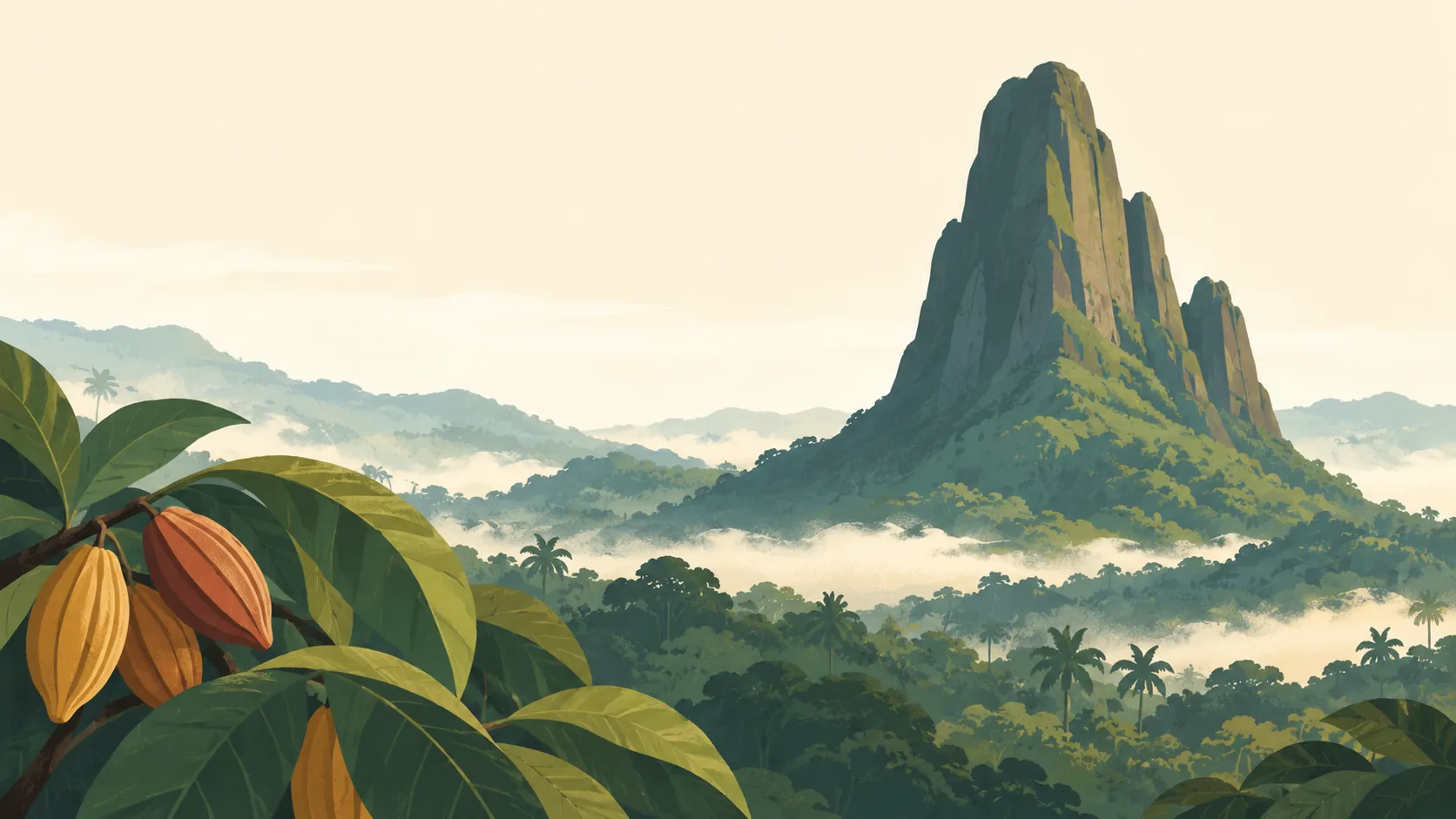


Interior & Ôbo: what to expect
The interior needs a local guide and route choices suited to recent weather. The forest is not an unrestricted network of easy paths. This travel base guide groups the destination into six useful areas so the stay works on the ground, not only on a country map.
Is this your trip?
Who Interior & Ôbo is for
Cocoa and coffee context travellers
The interior needs a local guide and route choices suited to recent weather. The forest is not an unrestricted network of easy paths.
Travellers with 2–3 days
That window gives Interior & Ôbo enough room for one anchor area and one contrasting cluster per day.
Trail gateway
Bom Sucesso and Botanical garden area make that interest practical rather than a country-level promise.
Area-led planners
Six fixed clusters make it easier to choose a base and avoid repeated cross-destination transfers.
Maybe not for you: A compressed checklist is the weak version of Interior & Ôbo. Never improvise a rainforest or volcanic-plug climb; heavy rain can make routes unsuitable.
Season by season
When to visit Interior & Ôbo
The locally drier months; conditions vary by coast. Rounded equatorial planning normals: heat, humidity and rain in every month, with local rather than four-season shifts. Conditions can still change sharply by elevation, coast and exposure, so use the chart for route timing and the current forecast for the day itself.
- Best
Drier window
Varies locally
Lower monthly rain improves roads, water visibility and longer outdoor days.
- Good
Shoulder
Varies locally
Mixed sun and heavy showers usually still support a flexible itinerary.
- Mixed
Wetter window
Varies locally
Humidity, rough water and road delays matter more than small temperature changes.
- Good
Year-round
All months
Start early, protect electronics and keep one weather-flexible day in every base.
Weather · monthly normals
Rounded equatorial planning normals: heat, humidity and rain in every month, with local rather than four-season shifts. Values are rounded planning normals rather than a live forecast.
Do fewer things better
Things to do in Interior & Ôbo
A short, ordered set of experiences with the timing or planning catch that makes each one work.
- 1
Start with Monte Café
Monte Café
Check current roça and museum access.
- 2
Walk Bom Sucesso without stacking it
Bom Sucesso
Meet the authorised guide and check conditions.
- 3
Use Botanical garden area for forest context
Botanical garden area
Confirm current visitor arrangements.
- 4
Give Lagoa Amélia route a deliberate half-day
Lagoa Amélia route
Wet ground and cloud affect the route.
- 5
See Bombaim valley outside peak hours
Bombaim valley
Arrange access and transport ahead.
- 6
Keep Pico Cão Grande approach weather-flexible
Pico Cão Grande approach
Viewing is separate from specialist climbing.
Never improvise a rainforest or volcanic-plug climb; heavy rain can make routes unsuitable.
Area by area
The areas of Interior & Ôbo
A real map at local-city scale: enough geography to choose a base, compare areas and group a day. Numbered places match the notes below.
| Area | What it is like | Why go |
|---|---|---|
1 Monte Café cocoa and coffee context | Check current roça and museum access. | Use Monte Café when cocoa and coffee context matters more than crossing the whole destination. |
2 Bom Sucesso trail gateway | Meet the authorised guide and check conditions. | Use Bom Sucesso when trail gateway matters more than crossing the whole destination. |
3 Botanical garden area forest context | Confirm current visitor arrangements. | Use Botanical garden area when forest context matters more than crossing the whole destination. |
4 Lagoa Amélia route guided walk | Wet ground and cloud affect the route. | Use Lagoa Amélia route when guided walk matters more than crossing the whole destination. |
5 Bombaim valley forest stays | Arrange access and transport ahead. | Use Bombaim valley when forest stays matters more than crossing the whole destination. |
6 Pico Cão Grande approach landscape | Viewing is separate from specialist climbing. | Use Pico Cão Grande approach when landscape matters more than crossing the whole destination. |
Choose the base, then the hotel
Where to stay in Interior & Ôbo
For most first visits: Monte Café for cocoa and coffee context.
Monte Café
Check current roça and museum access. Choose it when that trade-off should shape mornings and evenings.
Bom Sucesso
Meet the authorised guide and check conditions. Choose it when that trade-off should shape mornings and evenings.
Botanical garden area
Confirm current visitor arrangements. Choose it when that trade-off should shape mornings and evenings.
Lagoa Amélia route
Wet ground and cloud affect the route. Choose it when that trade-off should shape mornings and evenings.
Order with a point of view
What to eat in Interior & Ôbo
Local food is more useful as an area decision than as a checklist of famous dishes.
- 01
Calulu
Monte Café
A rich fish or meat stew with greens is a local staple.
- 02
Grilled fish
Bom Sucesso
Coastal meals depend on the day’s catch.
- 03
Breadfruit
Botanical garden area
Roasted or cooked breadfruit often accompanies fish.
- 04
Banana preparations
Lagoa Amélia route
Different varieties appear boiled, fried and in sweets.
- 05
Local chocolate
Bombaim valley
Visit small cocoa producers and ask about sourcing and processing.
Useful on the ground
Local tips for Interior & Ôbo
Plan the transfer, not only the distance
Never improvise a rainforest or volcanic-plug climb; heavy rain can make routes unsuitable.
Check entry before buying flights
Check the official visa, entry-authorisation and onward-ticket requirements for your passport before booking. Confirm any vaccination documentation required by your arrival and transit route.
São Tomé and Príncipe dobra and payments
Carry local cash for small restaurants, markets and transport. Confirm card acceptance and ATM access with remote accommodation before leaving the main arrival town.
Coverage and offline planning
Download maps, booking details and essential contacts before leaving Wi-Fi. Check roaming charges and local SIM registration requirements; remote routes may have no signal.
Type C/E sockets
220–230 V, 50 Hz; confirm the accommodation’s sockets.
Common questions
Quick answers about Interior & Ôbo
- When is the best time to visit Interior & Ôbo?
- The locally drier months; conditions vary by coast. Rounded equatorial planning normals: heat, humidity and rain in every month, with local rather than four-season shifts. Conditions can still change sharply by elevation, coast and exposure, so use the chart for route timing and the current forecast for the day itself.
- How many days do you need in Interior & Ôbo?
- 2–3 days. The interior needs a local guide and route choices suited to recent weather. The forest is not an unrestricted network of easy paths. This travel base guide groups the destination into six useful areas so the stay works on the ground, not only on a country map.
- Where should you stay in Interior & Ôbo?
- Monte Café for cocoa and coffee context. Check current roça and museum access. Choose it when that trade-off should shape mornings and evenings.
Keep building the route
Interior & Ôbo is part of São Tomé and Príncipe
Use the country guide for visa, money, long-distance transport and the route between cities. Then compare the other worked-out stops below.
- São Tomé cityMarkets and the island’s historical gateway
- Northern São ToméRoças, villages and a gentler first road day
- São João dos AngolaresA food-led stay on the green eastern road
- Porto Alegre & the southA remote green coast and the Rolas crossing
- PríncipeA separate stay of forest, bays and community life