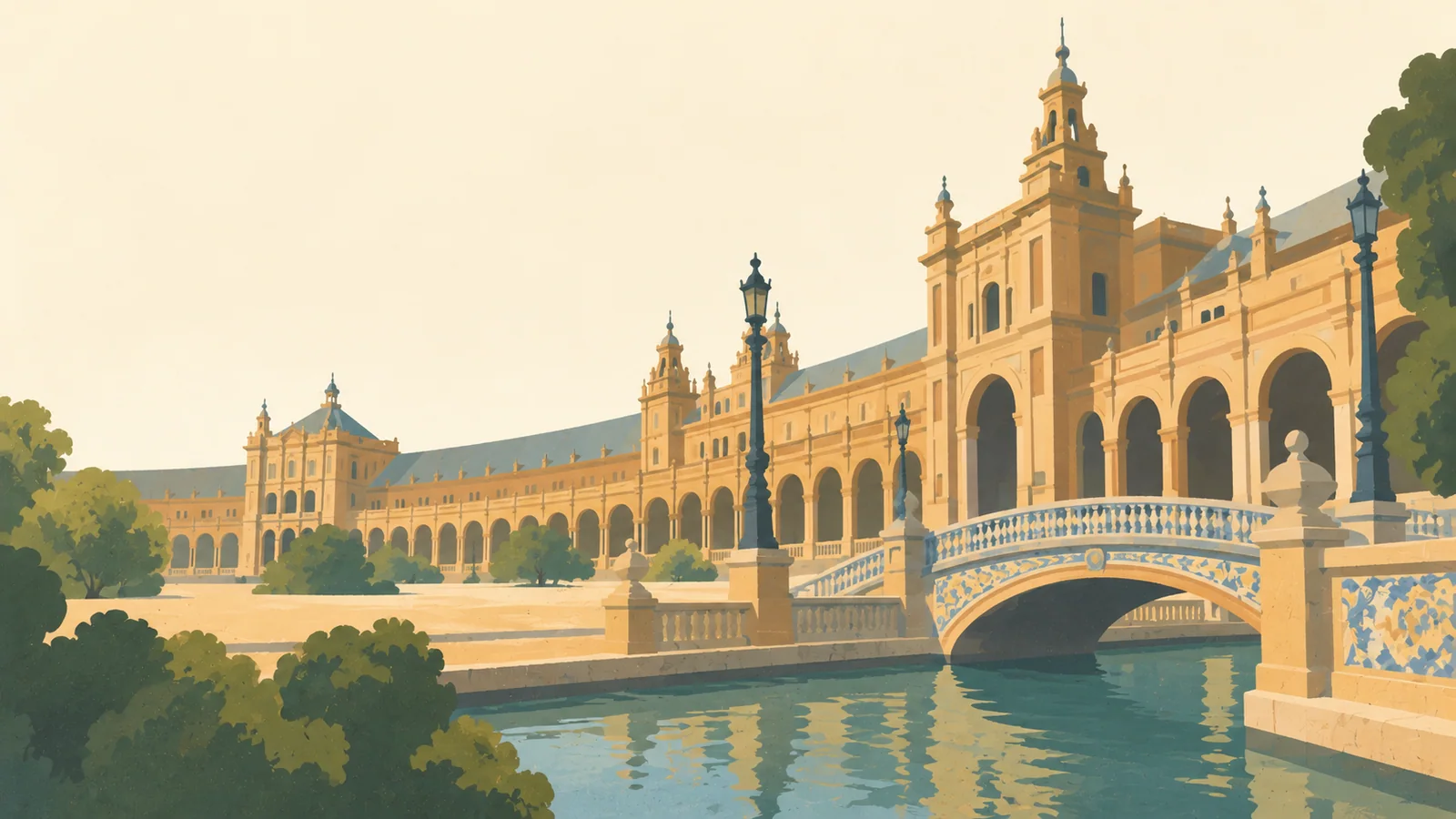


Seville: what to expect
The Alcázar, the largest Gothic cathedral in the world, Triana across the river, and the flamenco heartland. Too hot from mid-June to mid-September to enjoy. Between Semana Santa and Feria (roughly the whole of April) it is at its best and its most expensive; late March or October are the honest alternatives. This city guide groups the destination into six useful areas so the stay works on the ground, not only on a country map.
Is this your trip?
Who Seville is for
First-timers travellers
The Alcázar, the largest Gothic cathedral in the world, Triana across the river, and the flamenco heartland. Too hot from mid-June to mid-September to enjoy. Between Semana Santa and Feria (roughly the whole of April) it is at its best and its most expensive; late March or October are the honest alternatives.
Travellers with 2–3 days
That window gives Seville enough room for one anchor area and one contrasting cluster per day.
River and bullring history
Arenal and Triana make that interest practical rather than a country-level promise.
Area-led planners
Six fixed clusters make it easier to choose a base and avoid repeated cross-destination transfers.
Maybe not for you: A compressed checklist is the weak version of Seville. Summer heat is operational, not atmospheric; April festival and Holy Week dates transform access and prices
Season by season
When to visit Seville
April–June and September–October. Rounded Mediterranean planning normals: hot dry summers and mild, wetter winters. Conditions can still change sharply by elevation, coast and exposure, so use the chart for route timing and the current forecast for the day itself.
- Best
Spring
March–May
Mild days, green landscapes and rising demand around holidays.
- Mixed
Summer
June–August
Hot, bright and busy; shade and early starts materially improve city days.
- Best
Autumn
September–November
Warm early weeks, softer light and rain returning later in the season.
- Good
Winter
December–February
Cooler and wetter, with shorter hours but much lighter visitor pressure.
Weather · monthly normals
Rounded Mediterranean planning normals: hot dry summers and mild, wetter winters. Values are rounded planning normals rather than a live forecast.
Do fewer things better
Things to do in Seville
A short, ordered set of experiences with the timing or planning catch that makes each one work.
- 1
Start with Santa Cruz
Santa Cruz
Cathedral, Alcázar and shaded lanes in the most visited quarter
- 2
Walk Arenal without stacking it
Arenal
Guadalquivir frontage, market streets and easy monument access
- 3
Use Triana for ceramics and evenings
Triana
A living river quarter with workshops, market and flamenco venues
- 4
Give Alameda a deliberate half-day
Alameda
A broad northern promenade surrounded by bars and creative spaces
- 5
See Macarena outside peak hours
Macarena
City walls, basilica and calmer neighbourhood streets
- 6
Keep María Luisa & Plaza de España weather-flexible
María Luisa & Plaza de España
Shade, pavilions and the monumental 1929 exposition landscape
Summer heat is operational, not atmospheric; April festival and Holy Week dates transform access and prices
Area by area
The neighbourhoods of Seville
A real map at local-city scale: enough geography to choose a base, compare areas and group a day. Numbered places match the notes below.
| Area | What it is like | Why go |
|---|---|---|
1 Santa Cruz first monuments | Cathedral, Alcázar and shaded lanes in the most visited quarter | Use Santa Cruz when first monuments matters more than crossing the whole destination. |
2 Arenal river and bullring history | Guadalquivir frontage, market streets and easy monument access | Use Arenal when river and bullring history matters more than crossing the whole destination. |
3 Triana ceramics and evenings | A living river quarter with workshops, market and flamenco venues | Use Triana when ceramics and evenings matters more than crossing the whole destination. |
4 Alameda nightlife and local food | A broad northern promenade surrounded by bars and creative spaces | Use Alameda when nightlife and local food matters more than crossing the whole destination. |
5 Macarena churches and residential Seville | City walls, basilica and calmer neighbourhood streets | Use Macarena when churches and residential Seville matters more than crossing the whole destination. |
6 María Luisa & Plaza de España parks and grand design | Shade, pavilions and the monumental 1929 exposition landscape | Use María Luisa & Plaza de España when parks and grand design matters more than crossing the whole destination. |
Choose the base, then the hotel
Where to stay in Seville
For most first visits: Santa Cruz for first monuments.
Santa Cruz
Cathedral, Alcázar and shaded lanes in the most visited quarter Choose it when that trade-off should shape mornings and evenings.
Arenal
Guadalquivir frontage, market streets and easy monument access Choose it when that trade-off should shape mornings and evenings.
Triana
A living river quarter with workshops, market and flamenco venues Choose it when that trade-off should shape mornings and evenings.
Alameda
A broad northern promenade surrounded by bars and creative spaces Choose it when that trade-off should shape mornings and evenings.
Order with a point of view
What to eat in Seville
Local food is more useful as an area decision than as a checklist of famous dishes.
- 01
Espinacas con garbanzos
Santa Cruz
Spinach and chickpeas show the city Moorish pantry
- 02
Salmorejo
Arenal
Cold tomato and bread soup is essential in warm weather
- 03
Pringá montadito
Triana
Slow-cooked meats packed into a small roll reward a traditional bar
- 04
Pescaíto frito
Alameda
Order a shared paper portion where frying turnover is high
- 05
Torrijas
Macarena
The soaked fried sweet is especially visible around Holy Week
Useful on the ground
Local tips for Seville
Plan the transfer, not only the distance
Summer heat is operational, not atmospheric; April festival and Holy Week dates transform access and prices
Visa and borders
EU/EEA/Swiss citizens need only an ID card. UK, US, Canadian, Australian and NZ passports get 90 days in any 180 across the whole Schengen area, counted together with any other Schengen country. The EU's Entry/Exit System now registers biometrics at first entry (expect a slower queue); ETIAS, a €20 online pre-authorisation valid three years, is expected to become mandatory from late 2026 — check before you fly. Passport valid three months beyond departure and issued within the last ten years.
Money
Euro. Cards and phone wallets work almost everywhere; carry €50 or so for markets, village bars and the occasional taxi. At ATMs decline the 'conversion' offer (dynamic currency conversion) and expect a €2–6 fee from many Spanish banks on foreign cards — ask your bank which network is free. Nothing needs cash in Madrid or Barcelona.
SIM and data
EU SIMs roam at home rates. Everyone else: an eSIM bought before departure (Airalo, Holafly, or a Spanish operator's own prepaid eSIM from Orange, Vodafone or Simyo) is cheaper than the airport counter. 5G coverage is good in cities and on the AVE. Apps that matter: Renfe (or Trainline/Omio, which sell all three rail operators), ALSA, Cabify and Bolt for taxis, Moovit or Google Maps for city transit, TheFork for restaurant bookings.
Plugs and power
Type C and F (European two-pin) at 230 V, 50 Hz. UK and US visitors need an adapter; most modern chargers handle the voltage.
Common questions
Quick answers about Seville
- When is the best time to visit Seville?
- April–June and September–October. Rounded Mediterranean planning normals: hot dry summers and mild, wetter winters. Conditions can still change sharply by elevation, coast and exposure, so use the chart for route timing and the current forecast for the day itself.
- How many days do you need in Seville?
- 2–3 days. The Alcázar, the largest Gothic cathedral in the world, Triana across the river, and the flamenco heartland. Too hot from mid-June to mid-September to enjoy. Between Semana Santa and Feria (roughly the whole of April) it is at its best and its most expensive; late March or October are the honest alternatives. This city guide groups the destination into six useful areas so the stay works on the ground, not only on a country map.
- Where should you stay in Seville?
- Santa Cruz for first monuments. Cathedral, Alcázar and shaded lanes in the most visited quarter Choose it when that trade-off should shape mornings and evenings.
Keep building the route
Seville is part of Spain
Use the country guide for visa, money, long-distance transport and the route between cities. Then compare the other worked-out stops below.