
Paramaribo: what to expect
The capital’s compact historic core rewards early walking and a separate food-led afternoon. Shade and rain breaks make the pace more comfortable. This city guide groups the destination into six useful areas so the stay works on the ground, not only on a country map.
Is this your trip?
Who Paramaribo is for
Riverfront travellers
The capital’s compact historic core rewards early walking and a separate food-led afternoon. Shade and rain breaks make the pace more comfortable.
Travellers with 2–3 days
That window gives Paramaribo enough room for one anchor area and one contrasting cluster per day.
History
Fort Zeelandia and Independence Square make that interest practical rather than a country-level promise.
Area-led planners
Six fixed clusters make it easier to choose a base and avoid repeated cross-destination transfers.
Maybe not for you: A compressed checklist is the weak version of Paramaribo. Use local advice for daylight walking and arrange transport after dark.
Season by season
When to visit Paramaribo
The locally drier months; conditions vary by coast. Rounded equatorial planning normals: heat, humidity and rain in every month, with local rather than four-season shifts. Conditions can still change sharply by elevation, coast and exposure, so use the chart for route timing and the current forecast for the day itself.
- Best
Drier window
Varies locally
Lower monthly rain improves roads, water visibility and longer outdoor days.
- Good
Shoulder
Varies locally
Mixed sun and heavy showers usually still support a flexible itinerary.
- Mixed
Wetter window
Varies locally
Humidity, rough water and road delays matter more than small temperature changes.
- Good
Year-round
All months
Start early, protect electronics and keep one weather-flexible day in every base.
Weather · monthly normals
Rounded equatorial planning normals: heat, humidity and rain in every month, with local rather than four-season shifts. Values are rounded planning normals rather than a live forecast.
Do fewer things better
Things to do in Paramaribo
A short, ordered set of experiences with the timing or planning catch that makes each one work.
- 1
Start with Waterkant
Waterkant
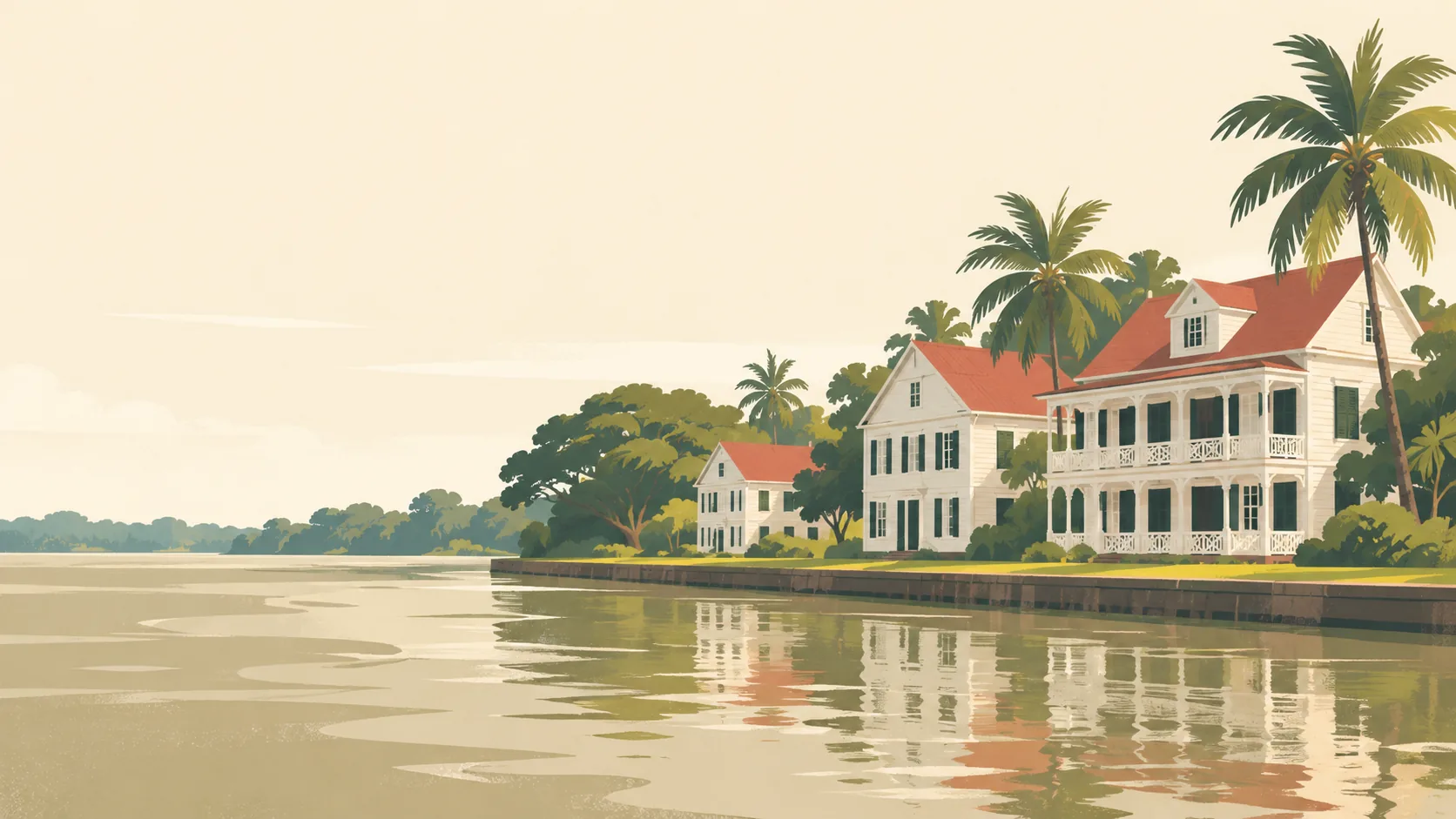
Historic timber streets face the Suriname River.
- 2
Walk Fort Zeelandia without stacking it
Fort Zeelandia
Visit with context about colonial and modern violence.
- 3
Use Independence Square for orientation
Independence Square
Civic buildings frame the central district.
- 4
Give Saint Peter and Paul Cathedral a deliberate half-day
Saint Peter and Paul Cathedral
Confirm visitor hours and dress respectfully.
- 5
See Central Market outside peak hours
Central Market
Morning is useful for produce and everyday trade.
- 6
Keep Blauwgrond weather-flexible
Blauwgrond
The district adds a distinct culinary chapter.
Use local advice for daylight walking and arrange transport after dark.
Area by area
The neighbourhoods of Paramaribo
A real map at local-city scale: enough geography to choose a base, compare areas and group a day. Numbered places match the notes below.
| Area | What it is like | Why go |
|---|---|---|
1 Waterkant riverfront | Historic timber streets face the Suriname River. | Use Waterkant when riverfront matters more than crossing the whole destination. |
2 Fort Zeelandia history | Visit with context about colonial and modern violence. | Use Fort Zeelandia when history matters more than crossing the whole destination. |
3 Independence Square orientation | Civic buildings frame the central district. | Use Independence Square when orientation matters more than crossing the whole destination. |
4 Saint Peter and Paul Cathedral architecture | Confirm visitor hours and dress respectfully. | Use Saint Peter and Paul Cathedral when architecture matters more than crossing the whole destination. |
5 Central Market food | Morning is useful for produce and everyday trade. | Use Central Market when food matters more than crossing the whole destination. |
6 Blauwgrond Javanese food | The district adds a distinct culinary chapter. | Use Blauwgrond when Javanese food matters more than crossing the whole destination. |
Choose the base, then the hotel
Where to stay in Paramaribo
For most first visits: Waterkant for riverfront.
Waterkant
Historic timber streets face the Suriname River. Choose it when that trade-off should shape mornings and evenings.
Fort Zeelandia
Visit with context about colonial and modern violence. Choose it when that trade-off should shape mornings and evenings.
Independence Square
Civic buildings frame the central district. Choose it when that trade-off should shape mornings and evenings.
Saint Peter and Paul Cathedral
Confirm visitor hours and dress respectfully. Choose it when that trade-off should shape mornings and evenings.
Order with a point of view
What to eat in Paramaribo
Local food is more useful as an area decision than as a checklist of famous dishes.
- 01
Pom
Waterkant
A baked dish based on pomtajer is a distinctive Surinamese favourite.
- 02
Saoto
Fort Zeelandia
Javanese-Surinamese chicken soup makes a rich everyday meal.
- 03
Roti
Independence Square
Flatbread with curry and vegetables reflects Hindustani kitchens.
- 04
Moksi alesi
Saint Peter and Paul Cathedral
Mixed rice dishes connect several culinary traditions.
- 05
Bara
Central Market
Fried lentil-based snacks are common street food.
Useful on the ground
Local tips for Paramaribo
Plan the transfer, not only the distance
Use local advice for daylight walking and arrange transport after dark.
Check entry before buying flights
Check current Surinamese entry-fee, e-visa and arrival rules for your nationality and purpose. Confirm any yellow-fever documentation required by your transit and onward route.
Surinamese dollar and payments
Carry local cash for small restaurants, markets and transport. Confirm card acceptance and ATM access with remote accommodation before leaving the main arrival town.
Coverage and offline planning
Download maps, booking details and essential contacts before leaving Wi-Fi. Check roaming charges and local SIM registration requirements; remote routes may have no signal.
Mixed socket types
Check the specific accommodation’s sockets and voltage; carry an appropriate adapter and charging backup.
Common questions
Quick answers about Paramaribo
- When is the best time to visit Paramaribo?
- The locally drier months; conditions vary by coast. Rounded equatorial planning normals: heat, humidity and rain in every month, with local rather than four-season shifts. Conditions can still change sharply by elevation, coast and exposure, so use the chart for route timing and the current forecast for the day itself.
- How many days do you need in Paramaribo?
- 2–3 days. The capital’s compact historic core rewards early walking and a separate food-led afternoon. Shade and rain breaks make the pace more comfortable. This city guide groups the destination into six useful areas so the stay works on the ground, not only on a country map.
- Where should you stay in Paramaribo?
- Waterkant for riverfront. Historic timber streets face the Suriname River. Choose it when that trade-off should shape mornings and evenings.
Keep building the route
Paramaribo is part of Suriname
Use the country guide for visa, money, long-distance transport and the route between cities. Then compare the other worked-out stops below.
- CommewijnePlantation river history across from the capital
- Upper Suriname RiverMaroon community stays and forest time
- Brokopondo & BrownsbergReservoir landscapes and guided forest walks
- Nickerie & Bigi PanWestern wetlands and a working coastal town
- Para & the central savannaForest edges and an easier inland chapter