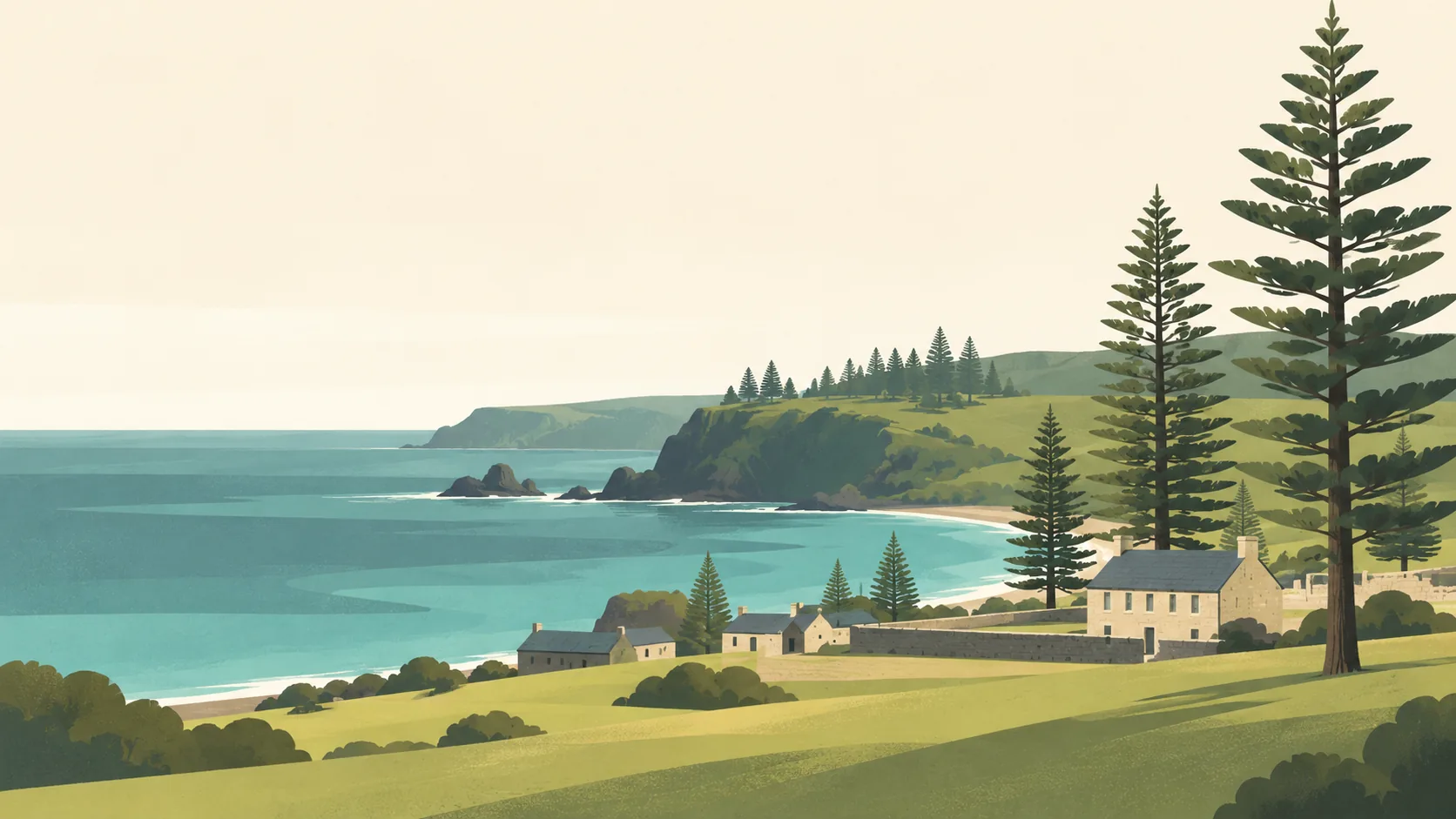


Emily Bay & Slaughter Bay: what to expect
Choose water activity from current conditions and local guidance; reef and historical sites need careful treatment. This travel base guide groups the destination into six useful areas so the stay works on the ground, not only on a country map.
Is this your trip?
Who Emily Bay & Slaughter Bay is for
Current swimming advice travellers
Choose water activity from current conditions and local guidance; reef and historical sites need careful treatment.
Travellers with 2–3 days
That window gives Emily Bay & Slaughter Bay enough room for one anchor area and one contrasting cluster per day.
Reef conservation
Slaughter Bay and Lone Pine area make that interest practical rather than a country-level promise.
Area-led planners
Six fixed clusters make it easier to choose a base and avoid repeated cross-destination transfers.
Maybe not for you: A compressed checklist is the weak version of Emily Bay & Slaughter Bay. Check current access, local permissions and the return connection; keep remote or weather-sensitive transport away from the international departure day.
Season by season
When to visit Emily Bay & Slaughter Bay
October–April for warmer days; walking is possible with suitable conditions year-round. Regional proxy near Kingston for this compact destination. Rounded NASA POWER 2001–2020 daily model averages near Kingston. Temperatures are mean daily highs/lows; rainfall is the mean monthly total. A coarse grid can smooth coastal and mountain differences; this is not a forecast. Conditions can still change sharply by elevation, coast and exposure, so use the chart for route timing and the current forecast for the day itself.
- Best
Summer
December–February
Warmer days suit a mix of heritage, walking and current-condition coast visits.
- Good
Autumn
March–May
Mild walking weather with rain possible.
- Mixed
Winter
June–August
Cooler, often wetter days and wind need flexible outdoor plans.
- Good
Spring
September–November
Warming conditions and gardens suit unhurried island days.
Weather · monthly normals
Regional proxy near Kingston for this compact destination. Rounded NASA POWER 2001–2020 daily model averages near Kingston. Temperatures are mean daily highs/lows; rainfall is the mean monthly total. A coarse grid can smooth coastal and mountain differences; this is not a forecast. Values are rounded planning normals rather than a live forecast.
Do fewer things better
Things to do in Emily Bay & Slaughter Bay
A short, ordered set of experiences with the timing or planning catch that makes each one work.
- 1
Start with Emily Bay
Emily Bay
Emily Bay is a useful cluster for current swimming advice, with enough substance for an unhurried half-day.
- 2
Walk Slaughter Bay without stacking it
Slaughter Bay
Slaughter Bay is a useful cluster for reef conservation, with enough substance for an unhurried half-day.
- 3
Use Lone Pine area for landscape
Lone Pine area
Lone Pine area is a useful cluster for landscape, with enough substance for an unhurried half-day.
- 4
Give Salt House remains a deliberate half-day
Salt House remains
Salt House remains is a useful cluster for heritage, with enough substance for an unhurried half-day.
- 5
See Coastal grasslands outside peak hours
Coastal grasslands
Coastal grasslands is a useful cluster for walking, with enough substance for an unhurried half-day.
- 6
Keep Kingston approaches weather-flexible
Kingston approaches
Kingston approaches is a useful cluster for shared history, with enough substance for an unhurried half-day.
Check current access, local permissions and the return connection; keep remote or weather-sensitive transport away from the international departure day.
Area by area
The areas of Emily Bay & Slaughter Bay
A real map at local-city scale: enough geography to choose a base, compare areas and group a day. Numbered places match the notes below.
| Area | What it is like | Why go |
|---|---|---|
1 Emily Bay current swimming advice | Emily Bay is a useful cluster for current swimming advice, with enough substance for an unhurried half-day. | Use Emily Bay when current swimming advice matters more than crossing the whole destination. |
2 Slaughter Bay reef conservation | Slaughter Bay is a useful cluster for reef conservation, with enough substance for an unhurried half-day. | Use Slaughter Bay when reef conservation matters more than crossing the whole destination. |
3 Lone Pine area landscape | Lone Pine area is a useful cluster for landscape, with enough substance for an unhurried half-day. | Use Lone Pine area when landscape matters more than crossing the whole destination. |
4 Salt House remains heritage | Salt House remains is a useful cluster for heritage, with enough substance for an unhurried half-day. | Use Salt House remains when heritage matters more than crossing the whole destination. |
5 Coastal grasslands walking | Coastal grasslands is a useful cluster for walking, with enough substance for an unhurried half-day. | Use Coastal grasslands when walking matters more than crossing the whole destination. |
6 Kingston approaches shared history | Kingston approaches is a useful cluster for shared history, with enough substance for an unhurried half-day. | Use Kingston approaches when shared history matters more than crossing the whole destination. |
Choose the base, then the hotel
Where to stay in Emily Bay & Slaughter Bay
For most first visits: Emily Bay for current swimming advice.
Emily Bay
Emily Bay is a useful cluster for current swimming advice, with enough substance for an unhurried half-day. Choose it when that trade-off should shape mornings and evenings.
Slaughter Bay
Slaughter Bay is a useful cluster for reef conservation, with enough substance for an unhurried half-day. Choose it when that trade-off should shape mornings and evenings.
Lone Pine area
Lone Pine area is a useful cluster for landscape, with enough substance for an unhurried half-day. Choose it when that trade-off should shape mornings and evenings.
Salt House remains
Salt House remains is a useful cluster for heritage, with enough substance for an unhurried half-day. Choose it when that trade-off should shape mornings and evenings.
Order with a point of view
What to eat in Emily Bay & Slaughter Bay
Local food is more useful as an area decision than as a checklist of famous dishes.
- 01
Island fish
Emily Bay
Choose legal seasonal catch from trusted kitchens.
- 02
Local beef
Slaughter Bay
Farm produce contributes to island menus.
- 03
Pilhi
Lone Pine area
A traditional baked dish with island variations.
- 04
Seasonal garden produce
Salt House remains
Local growing and supply shape what is available.
- 05
Community baking
Coastal grasslands
Ask hosts about local recipes and food history.
Useful on the ground
Local tips for Emily Bay & Slaughter Bay
Plan the transfer, not only the distance
Check current access, local permissions and the return connection; keep remote or weather-sensitive transport away from the international departure day.
Check entry before buying flights
Check Australian and territory-specific arrival documentation, passport or identity requirements and every transit country for your actual route. Confirm biosecurity restrictions before packing; do not assume the same process as a mainland domestic flight.
Australian dollar and payments
Australian dollar is used. Confirm card and ATM access, the currency of quoted prices and suitable cash before remote or smaller-island stays.
Coverage and offline planning
Download maps, booking details and essential contacts before leaving Wi-Fi. Check roaming charges and local SIM registration requirements; remote routes may have no signal.
Check socket type and voltage
Confirm the accommodation’s electricity supply and bring an appropriate adapter; remote stays may have limited charging.
Common questions
Quick answers about Emily Bay & Slaughter Bay
- When is the best time to visit Emily Bay & Slaughter Bay?
- October–April for warmer days; walking is possible with suitable conditions year-round. Regional proxy near Kingston for this compact destination. Rounded NASA POWER 2001–2020 daily model averages near Kingston. Temperatures are mean daily highs/lows; rainfall is the mean monthly total. A coarse grid can smooth coastal and mountain differences; this is not a forecast. Conditions can still change sharply by elevation, coast and exposure, so use the chart for route timing and the current forecast for the day itself.
- How many days do you need in Emily Bay & Slaughter Bay?
- 2–3 days. Choose water activity from current conditions and local guidance; reef and historical sites need careful treatment. This travel base guide groups the destination into six useful areas so the stay works on the ground, not only on a country map.
- Where should you stay in Emily Bay & Slaughter Bay?
- Emily Bay for current swimming advice. Emily Bay is a useful cluster for current swimming advice, with enough substance for an unhurried half-day. Choose it when that trade-off should shape mornings and evenings.
Keep building the route
Emily Bay & Slaughter Bay is part of Norfolk Island
Use the country guide for visa, money, long-distance transport and the route between cities. Then compare the other worked-out stops below.
- KingstonA World Heritage landscape with several layers of history
- Burnt PineThe practical centre for food, shops and island arrangements
- Norfolk Island National ParkNative forest, high viewpoints and marked walking tracks
- Anson Bay & northwest coastGreen cliffs and a separate northwestern coast day
- Eastern NorfolkRural lanes, heritage interpretation and exposed coast