
Samarkand: what to expect
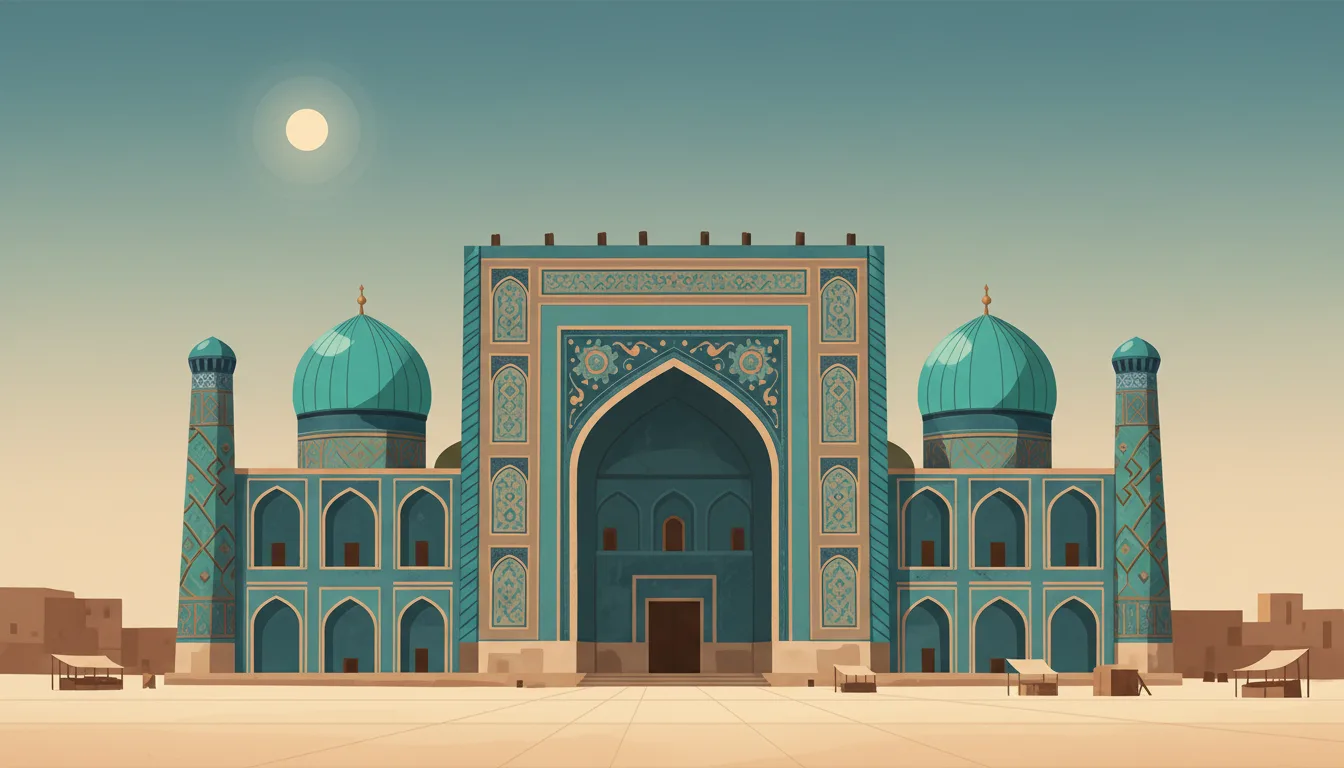
The Registan's three madrasas, Gur-e-Amir, Shah-i-Zinda's tiled necropolis and Bibi-Khanym anchor a city that is also a modern regional capital with a Tajik-speaking old quarter and the Siyob bazaar. This city guide groups the destination into six useful areas so the stay works on the ground, not only on a country map.
Is this your trip?
Who Samarkand is for
Architecture travellers
The Registan's three madrasas, Gur-e-Amir, Shah-i-Zinda's tiled necropolis and Bibi-Khanym anchor a city that is also a modern regional capital with a Tajik-speaking old quarter and the Siyob bazaar.
Travellers with 2–3 days
That window gives Samarkand enough room for one anchor area and one contrasting cluster per day.
Tiled necropolis
Shah-i-Zinda and Gur-e-Amir make that interest practical rather than a country-level promise.
Area-led planners
Six fixed clusters make it easier to choose a base and avoid repeated cross-destination transfers.
Maybe not for you: A compressed checklist is the weak version of Samarkand. Treat the suggested stay as time on the ground: weather, timed entry, ferries or mountain roads can remove half a day.
Season by season
When to visit Samarkand
May–June and September. Rounded continental planning normals: cold winters, warm summers and a fast-changing shoulder season. Conditions can still change sharply by elevation, coast and exposure, so use the chart for route timing and the current forecast for the day itself.
- Good
Spring
March–May
Rapid warming, blossom and occasional cold reversals; layer for long days.
- Best
Summer
June–August
Warm to hot with long daylight and thunderstorms rather than constant rain.
- Best
Autumn
September–November
September is excellent; temperatures and daylight fall quickly after it.
- Mixed
Winter
December–February
Cold, sometimes snowy and atmospheric, with museums carrying shorter days.
Weather · monthly normals
Rounded continental planning normals: cold winters, warm summers and a fast-changing shoulder season. Values are rounded planning normals rather than a live forecast.
Do fewer things better
Things to do in Samarkand
A short, ordered set of experiences with the timing or planning catch that makes each one work.
- 1
Start with Registan
Registan
Ulugh Beg, Sher-Dor and Tilya-Kori around the central square
- 2
Walk Shah-i-Zinda without stacking it
Shah-i-Zinda
An avenue of mausoleums with the finest tilework in Central Asia
- 3
Use Gur-e-Amir for Timur's tomb
Gur-e-Amir
The domed mausoleum that inspired Mughal architecture
- 4
Give Bibi-Khanym & Siyob Bazaar a deliberate half-day
Bibi-Khanym & Siyob Bazaar
The vast ruined mosque beside the city's main produce and bread market
- 5
See Old Tajik quarter outside peak hours
Old Tajik quarter
Mud-walled streets between the monuments where most courtyard guesthouses sit
- 6
Keep Ulugh Beg observatory & Afrosiyab weather-flexible
Ulugh Beg observatory & Afrosiyab
The sextant remains and the museum of the pre-Mongol city on the northern edge
Treat the suggested stay as time on the ground: weather, timed entry, ferries or mountain roads can remove half a day.
Area by area
The neighbourhoods of Samarkand
A real map at local-city scale: enough geography to choose a base, compare areas and group a day. Numbered places match the notes below.
| Area | What it is like | Why go |
|---|---|---|
1 Registan the three madrasas | Ulugh Beg, Sher-Dor and Tilya-Kori around the central square | Use Registan when the three madrasas matters more than crossing the whole destination. |
2 Shah-i-Zinda tiled necropolis | An avenue of mausoleums with the finest tilework in Central Asia | Use Shah-i-Zinda when tiled necropolis matters more than crossing the whole destination. |
3 Gur-e-Amir Timur's tomb | The domed mausoleum that inspired Mughal architecture | Use Gur-e-Amir when Timur's tomb matters more than crossing the whole destination. |
4 Bibi-Khanym & Siyob Bazaar mosque and market | The vast ruined mosque beside the city's main produce and bread market | Use Bibi-Khanym & Siyob Bazaar when mosque and market matters more than crossing the whole destination. |
5 Old Tajik quarter guesthouses and lanes | Mud-walled streets between the monuments where most courtyard guesthouses sit | Use Old Tajik quarter when guesthouses and lanes matters more than crossing the whole destination. |
6 Ulugh Beg observatory & Afrosiyab astronomy and ancient city | The sextant remains and the museum of the pre-Mongol city on the northern edge | Use Ulugh Beg observatory & Afrosiyab when astronomy and ancient city matters more than crossing the whole destination. |
Choose the base, then the hotel
Where to stay in Samarkand
For most first visits: Registan for the three madrasas.
Registan
Ulugh Beg, Sher-Dor and Tilya-Kori around the central square Choose it when that trade-off should shape mornings and evenings.
Shah-i-Zinda
An avenue of mausoleums with the finest tilework in Central Asia Choose it when that trade-off should shape mornings and evenings.
Gur-e-Amir
The domed mausoleum that inspired Mughal architecture Choose it when that trade-off should shape mornings and evenings.
Bibi-Khanym & Siyob Bazaar
The vast ruined mosque beside the city's main produce and bread market Choose it when that trade-off should shape mornings and evenings.
Order with a point of view
What to eat in Samarkand
Local food is more useful as an area decision than as a checklist of famous dishes.
- 01
Plov at midday
Registan
The national rice dish cooked in a giant kazan; eat it at lunch where locals do, and never as a late dinner
- 02
Non from a tandir
Shah-i-Zinda
Each city stamps its own bread pattern; buy it warm from a bazaar oven and never place it upside down
- 03
Samsa and shashlik
Gur-e-Amir
Tandir-baked pastries and skewers from a street stand make the fastest, cheapest lunch between monuments
- 04
Lagman or shurpa
Bibi-Khanym & Siyob Bazaar
Hand-pulled noodles and slow-cooked soups reflect Uyghur and steppe cooking in every regional café
- 05
Bazaar fruit and green tea
Old Tajik quarter
Melons, grapes, apricots and pomegranates by season, with tea poured three times as hospitality
Useful on the ground
Local tips for Samarkand
Plan the transfer, not only the distance
Treat the suggested stay as time on the ground: weather, timed entry, ferries or mountain roads can remove half a day.
Visa-free or e-visa, with hotel registration
Most European, British, Australian, Canadian, Japanese and Korean passports get 30 days visa-free; others apply online for an e-visa. Hotels register you automatically; keep the slips and register privately arranged stays through the e-mehmon system to avoid trouble at exit.
Cash som from ATMs and exchange counters
Change dollars or euros at banks or hotel counters at the official rate; ATMs dispensing som and sometimes dollars are common in cities. Visa and Mastercard work in hotels and better restaurants, but bazaars, taxis and small towns want cash.
SIM with passport, fine in cities
Ucell, Beeline and Mobiuz sell tourist SIMs with cheap data on presentation of a passport; coverage is good in cities and along the train line, thin in the desert and around the Aral.
Type C and F sockets
Uzbekistan uses 220 V with European two-pin sockets, so most European plugs fit without an adapter.
Common questions
Quick answers about Samarkand
- When is the best time to visit Samarkand?
- May–June and September. Rounded continental planning normals: cold winters, warm summers and a fast-changing shoulder season. Conditions can still change sharply by elevation, coast and exposure, so use the chart for route timing and the current forecast for the day itself.
- How many days do you need in Samarkand?
- 2–3 days. The Registan's three madrasas, Gur-e-Amir, Shah-i-Zinda's tiled necropolis and Bibi-Khanym anchor a city that is also a modern regional capital with a Tajik-speaking old quarter and the Siyob bazaar. This city guide groups the destination into six useful areas so the stay works on the ground, not only on a country map.
- Where should you stay in Samarkand?
- Registan for the three madrasas. Ulugh Beg, Sher-Dor and Tilya-Kori around the central square Choose it when that trade-off should shape mornings and evenings.
Keep building the route
Samarkand is part of Uzbekistan
Use the country guide for visa, money, long-distance transport and the route between cities. Then compare the other worked-out stops below.
- TashkentSoviet-planned capital with a metro, markets and a modern edge
- BukharaCompact old city of brick mosques and trading domes
- KhivaWalled Itchan Kala on the edge of the Kyzylkum desert
- Fergana valleyCraft towns of silk, ceramics and knives
- Nukus & KarakalpakstanSavitsky museum, desert fortresses and the Aral shore