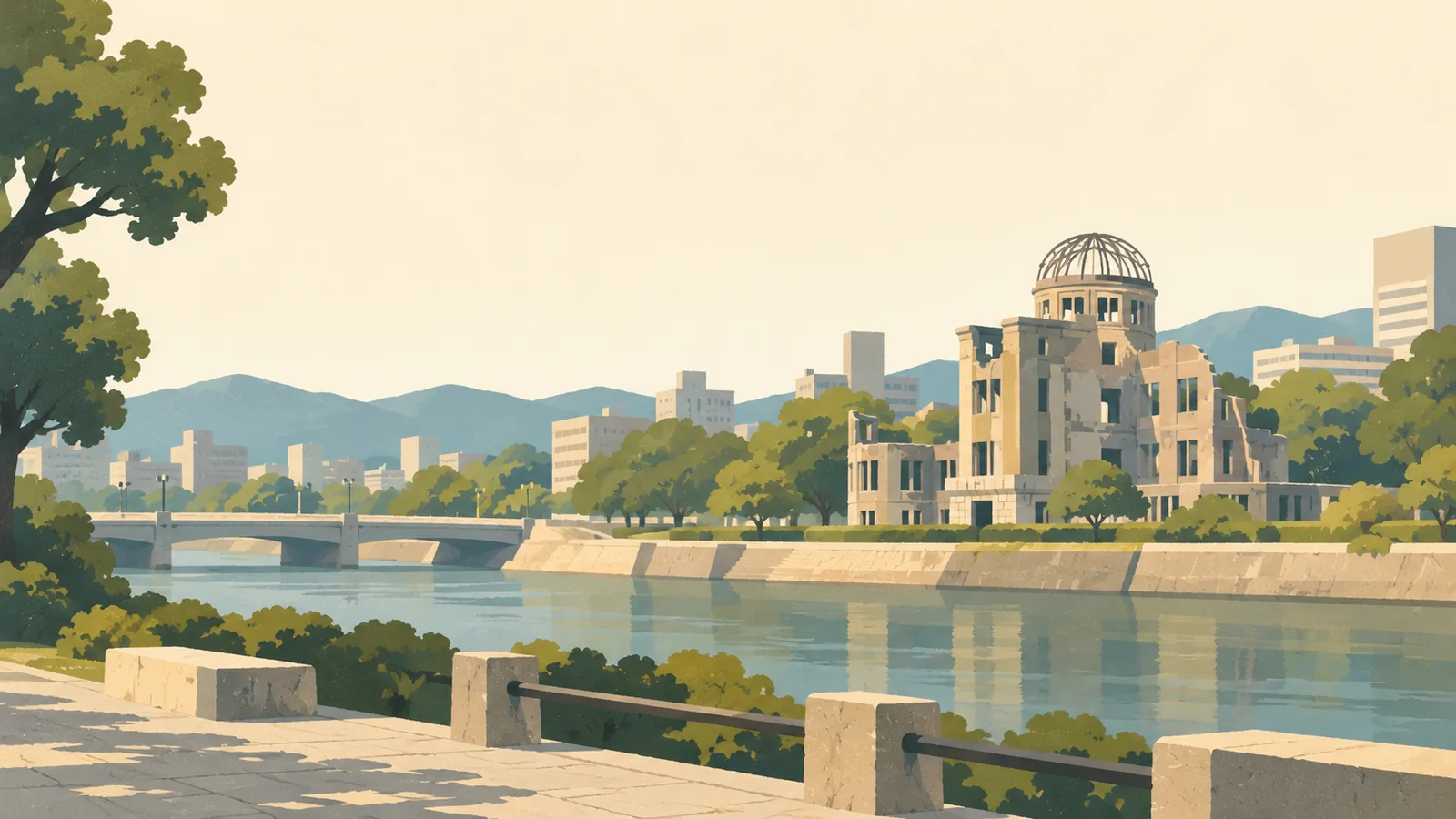


Hiroshima: what to expect
Hiroshima deserves more than a rushed museum-and-train day. The Peace Memorial Park needs emotional space, the city's rivers make walking easy, and Miyajima works better when it is not squeezed between two long rail journeys.
Is this your trip?
Who Hiroshima is for
History-minded travellers
The memorial landscape rewards time and context.
Island and city pairings
Miyajima adds forest, shrine and sea to a compact stop.
Food travellers
Hiroshima-style okonomiyaki and oysters are distinct regional anchors.
Rail itineraries
It breaks the Osaka–Fukuoka corridor naturally.
Maybe not for you: Do not schedule the Peace Museum immediately before a tight departure; the visit is not an efficient checkbox and should not be treated like one.
Season by season
When to visit Hiroshima
March–May and October–November. Spring and autumn are mild. June and early July are wet; August is hot and includes the 6 August memorial observance. Winter is cool and generally manageable.
- Best
Spring
March–May
Mild river walks and blossom, with Golden Week demand.
- Mixed
Rainy season
June–mid July
Frequent rain but good museum and food days.
- Mixed
Summer
Late July–September
Hot and humid; 6 August carries profound local significance.
- Good
Autumn and winter
October–February
Clear autumn is excellent; winter is quiet, cool and oyster season.
Weather · monthly normals
Hiroshima has hot humid summers, a rainy early summer and cool winters beside the Inland Sea.
Do fewer things better
Things to do in Hiroshima
A short, ordered set of experiences with the timing or planning catch that makes each one work.
- 1
Give the Peace Park and museum half a day
Naka Ward
Read slowly, leave space afterwards and avoid turning the dome into a photo prop.
- 2
Walk the rivers after the museum
Central Hiroshima
Water and ordinary city life provide necessary context and decompression.
- 3
Stay late or early on Miyajima
Itsukushima
The shrine and forest change when day groups leave; check tides for the torii.
- 4
Eat Hiroshima-style okonomiyaki
Hondori or a neighbourhood counter
Layered batter, cabbage, noodles and sauce are a full regional meal.
- 5
Ride a local tram
City centre
The streetcar network is simple, useful and part of the city's postwar continuity.
- 6
Consider one Inland Sea extension
Onomichi or islands
Cycling and port towns justify another night if the wider region interests you.
Area by area
The neighbourhoods of Hiroshima
A real map at local-city scale: enough geography to choose a base, compare areas and group a day. Numbered places match the notes below.
| Area | What it is like | Why go |
|---|---|---|
1 Peace Park & Hondori first visit | Memorial sites, covered shopping and central dining. | The best balanced base for two nights. |
2 Hiroshima Station rail convenience | New station district, hotels and fast onward connections. | Efficient, though less atmospheric after dinner. |
3 Shukkeien & Hakushima gardens and calm | Historic garden, museum and quieter river streets. | A gentle half-day beside the main station corridor. |
4 Yokogawa local evenings | Small bars and restaurants around a useful rail node. | Good for repeat visitors or value outside the centre. |
5 Ujina & waterfront port and architecture | Ferries, waterfront parks and modern cultural spaces. | Come for sea access rather than central sights. |
6 Miyajima shrine and forest | Sacred island, waterfront town and mountain trails. | Stay overnight when the island is a priority, not merely a photo. |
Choose the base, then the hotel
Where to stay in Hiroshima
For most first visits: Hondori for city access; Hiroshima Station for a one-night rail stop.
Hondori or Peace Boulevard
Walk to the memorial and eat nearby.
Hiroshima Station
Minimises luggage and early departure friction.
Hakushima or Yokogawa
Lower-key evenings with tram access.
Miyajima
Higher prices buy the quiet hours before and after day visitors.
Order with a point of view
What to eat in Hiroshima
Local food is more useful as an area decision than as a checklist of famous dishes.
- 01
Hiroshima okonomiyaki
Central counters
Noodles and layered cabbage distinguish it from Osaka's mixed batter.
- 02
Oysters
City and Miyajima
Winter is the strongest season; grilled, fried or simple preparations suit them.
- 03
Anago-meshi
Miyajima and Miyajimaguchi
Sea eel over rice is the classic island approach meal.
- 04
Tsukemen
Central Hiroshima
Cold noodles with a spicy dipping sauce make a lighter lunch.
- 05
Local sake
Saijo or city bars
Saijo is the deeper brewery trip; a focused tasting works in town.
Useful on the ground
Local tips for Hiroshima
The museum is emotionally demanding
Do not sandwich it between trains or entertainment.
Check the Miyajima tide table
High and low tide create different views; neither is inherently wrong.
Trams accept simple local payment
Have an IC card or exact-fare backup and exit as signed.
Deer are wild
Do not feed or tease them on Miyajima.
Atomic-bomb history needs precise language
Follow museum terminology and centre survivors rather than spectacle.
Common questions
Quick answers about Hiroshima
- When is the best time to visit Hiroshima?
- March–May and October–November. Spring and autumn are mild. June and early July are wet; August is hot and includes the 6 August memorial observance. Winter is cool and generally manageable.
- How many days do you need in Hiroshima?
- 2 nights. Hiroshima deserves more than a rushed museum-and-train day. The Peace Memorial Park needs emotional space, the city's rivers make walking easy, and Miyajima works better when it is not squeezed between two long rail journeys.
- Where should you stay in Hiroshima?
- Hondori for city access; Hiroshima Station for a one-night rail stop. Walk to the memorial and eat nearby.
Keep building the route
Hiroshima is part of Japan
Use the country guide for visa, money, long-distance transport and the route between cities. Then compare the other worked-out stops below.
- TokyoA hundred neighbourhoods pretending to be one city.
- KyotoThe old capital is best before breakfast and after dark.
- OsakaJapan's most convincing argument for eating after midnight.
- KanazawaGarden, craft and seafood at a scale you can actually hold.
- FukuokaA compact food city facing Korea across the water.