

Beijing: what to expect
Beijing is physically larger and historically denser than a short itinerary expects. Put one imperial site beside one lived-in neighbourhood each day, reserve the scarce entries, and give the Great Wall its own weather-aware day rather than treating it as a transfer stop.
Is this your trip?
Who Beijing is for
History travellers
Palaces, temples, walls and urban axes reward context rather than speed.
Food-led explorers
Imperial, northern and regional cooking coexist far beyond roast duck.
Architecture people
Courtyard lanes, monumental planning and contemporary projects sit in productive tension.
Early risers
Major sites and local parks are materially better at opening time.
Maybe not for you: Beijing is tiring if every day crosses the entire city. Do not combine the Summer Palace, 798 and a central evening merely because the metro map connects them.
Season by season
When to visit Beijing
April–May and September–October. Late spring and early autumn bring the best balance of clear air and comfortable walking. Winter is cold, dry and often bright; summer is hot, humid and stormy. Public-holiday weeks create exceptional domestic demand.
- Best
Spring
April–May
Dry, mild and sometimes dusty; parks and outer-wall walks are excellent.
- Mixed
Summer
June–August
Hot and humid with thunderstorms; start monumental sites early.
- Best
Autumn
September–October
Clear, crisp and the strongest all-round window, with holiday pressure in early October.
- Good
Winter
November–March
Very cold and dry, but major sites are quieter and skies can be striking.
Weather · monthly normals
Beijing has hot humid summers and cold, very dry winters; spring can be windy.
Do fewer things better
Things to do in Beijing
A short, ordered set of experiences with the timing or planning catch that makes each one work.
- 1
Enter the Forbidden City at the first slot
Dongcheng
The palace is a sequence of scale, detail and courtyards; reserve through the current official channel and bring the required ID.
- 2
Walk a hutong with purpose
Shichahai or Dongsi
Choose a living neighbourhood and a museum, temple or meal rather than photographing doorways as scenery.
- 3
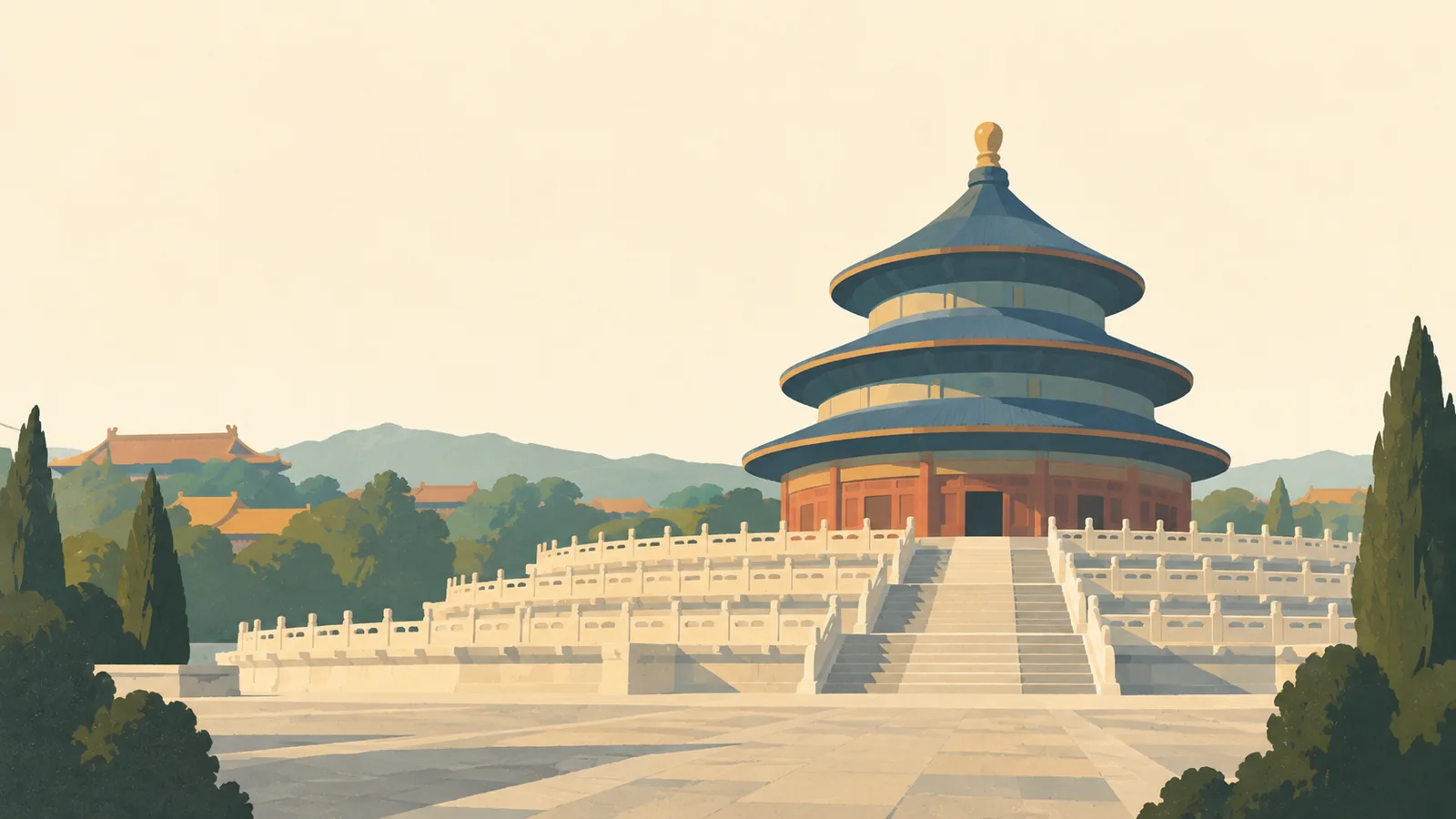
Give the Temple of Heaven a morning
Tiantan
Local exercise and the park's spatial design matter as much as the ceremonial halls.
- 4
Choose a less compressed Great Wall day
Mutianyu or another managed section
Weather, transfer and walking ability should determine the section; leave a full day.
- 5
Pair 798 with nearby contemporary culture
Chaoyang
The factory district works best with current exhibitions, not only outdoor photo stops.
- 6
See the central axis from Jingshan
Jingshan Park
The hill provides the clearest reading of imperial Beijing and the palace below.
Area by area
The neighbourhoods of Beijing
A real map at local-city scale: enough geography to choose a base, compare areas and group a day. Numbered places match the notes below.
| Area | What it is like | Why go |
|---|---|---|
1 Dongcheng hutongs history and first visit | Courtyard lanes, temples and small museums inside the old city. | The strongest base for dawn access and slow local walks. |
2 Qianmen & Dashilar old commerce | Restored shopfronts beside narrower historic commercial lanes. | Walk beyond the main pedestrian street to find more texture. |
3 Sanlitun dining and nightlife | Embassies, restaurants, retail and late evenings east of the centre. | Convenient for contemporary Beijing, less so for opening-time palace visits. |
4 Chaoyang Park families and open space | Large urban park, modern neighbourhoods and family attractions. | Useful breathing room in a dense east-side day. |
5 798 Art District contemporary art | Former industrial compounds filled with galleries and design spaces. | Check current exhibitions; the architecture alone is not a full day. |
6 Haidian & Summer Palace gardens and universities | Northwest campuses, lakes and imperial garden landscapes. | Treat it as a separate half- or full-day cluster. |
Choose the base, then the hotel
Where to stay in Beijing
For most first visits: Dongcheng inside the second ring for history; Sanlitun for contemporary evenings.
Dongcheng near Dongsi or Shichahai
Shorter dawn journeys and walkable evening lanes.
Wangfujing or Qianmen edge
Convenient to major sites; choose a side street over a tour-bus block.
Sanlitun or east Chaoyang
More international amenities and later evenings, longer rides to western sights.
Gulou or Andingmen
A neighbourhood rhythm with useful metro access and fewer monument-facing hotels.
Order with a point of view
What to eat in Beijing
Local food is more useful as an area decision than as a checklist of famous dishes.
- 01
Beijing roast duck
Established specialist restaurants
Reserve one considered meal and expect several ways of eating the bird, not only pancakes.
- 02
Zhajiangmian
Neighbourhood noodle shops
Wheat noodles, fermented-bean sauce and vegetables are everyday northern comfort food.
- 03
Lamb hotpot
Dongcheng and old specialists
Copper-pot cooking is especially convincing in cold weather.
- 04
Jianbing breakfast
Morning stalls
A crisp savoury pancake is best eaten immediately and close to where you are staying.
- 05
Regional Chinese cooking
Across Chaoyang and university districts
Use Beijing's scale to try cuisines from elsewhere in the country rather than repeating one northern menu.
Useful on the ground
Local tips for Beijing
Reserve major sites
Many headline attractions use dated, identity-linked entry; confirm the current official process before the day.
Carry the address in Chinese
A screenshot or hotel card resolves pronunciation and connectivity problems.
Prepare mobile payment before arrival
Set up the currently supported international-card route and keep a physical-card and cash fallback.
Distances exceed the map's impression
Metro exits and palace grounds can add kilometres after arrival.
Avoid national holiday assumptions
Early October and Lunar New Year periods change crowds, closures and transport demand dramatically.
Common questions
Quick answers about Beijing
- When is the best time to visit Beijing?
- April–May and September–October. Late spring and early autumn bring the best balance of clear air and comfortable walking. Winter is cold, dry and often bright; summer is hot, humid and stormy. Public-holiday weeks create exceptional domestic demand.
- How many days do you need in Beijing?
- 4–5 days. Beijing is physically larger and historically denser than a short itinerary expects. Put one imperial site beside one lived-in neighbourhood each day, reserve the scarce entries, and give the Great Wall its own weather-aware day rather than treating it as a transfer stop.
- Where should you stay in Beijing?
- Dongcheng inside the second ring for history; Sanlitun for contemporary evenings. Shorter dawn journeys and walkable evening lanes.
Keep building the route
Beijing is part of China
Use the country guide for visa, money, long-distance transport and the route between cities. Then compare the other worked-out stops below.
- ShanghaiA port city read best at street level, not from one tower.
- Xi'anA walled city where imperial China meets the Silk Roads.
- ChengduTea-house tempo, serious spice and a city larger than its mood.
- HangzhouA lake city whose calm survives if you leave the main causeway.
- GuilinKarst country where the best city guide points beyond the city.
- NanjingImperial history and a modern Yangtze city
- SuzhouClassical gardens beyond the Shanghai day trip
- ChongqingRiver confluences and a genuinely vertical city
- KunmingYunnan's highland capital and a useful slower base
- XiamenMaritime history and a coastal Fujian base
- QingdaoCoastal hills and a layered port history
- LuoyangAncient-capital history and Buddhist stone art
- HarbinNortheastern architecture and a deliberate winter city
- DalianA northern port city of squares and coastal walks
- GuangzhouCantonese food and a long trading history