
Who it's for
Is Faroe Islands right for your trip?
Every country is somebody's favourite. The honest question is whether it is yours, and for this trip.
This is your trip if…
- You want sea cliffs, seabirds and hiking without long drives or crowds.
- You accept wind and rain as the price of the landscape.
- You are happy with a car and a weather-flexible plan built around one base.
- You like small-scale food, wool and village culture over monuments.
Think twice if…
- You need guaranteed sunshine or fixed daily itineraries.
- You are on a tight budget; food, fuel and rooms are priced like Norway.
- You object to the traditional grindadráp pilot-whale hunt and will not visit a place that practises it.
- You want nightlife or a large city; Tórshavn has 22,000 people.
Best time to visit
When is the best time to visit Faroe Islands?
Late May–August for long light, puffins and open ferries; September for storms and fewer visitors. The Faroes have a cool oceanic climate with no dry month and little temperature range. Summer highs rarely pass fifteen degrees but days are twenty hours long, puffins nest on Mykines and all ferries run. Winter is dark, stormy and mild, with Atlantic depressions cancelling flights and boats; it suits storm-watching and Tórshavn culture, not island-hopping.
- Best
Early summer
Late May–June
Long light, nesting puffins from May, drier spells and Mykines boats running; book rooms months ahead.
- Best
High summer
July–August
Warmest weather, Ólavsøka in Tórshavn and the G! Festival; the fullest schedules and the highest prices.
- Good
Autumn
September–October
Storm colour and space on the roads, but Mykines boats stop and daylight shortens fast.
- Mixed
Winter
November–April
Dark, wet and windy with cancelled flights; northern lights are possible and rooms are cheap, but hiking is limited.
Climate · monthly normals
Cool, wet and windy in every month: winters hover around freezing without hard frost, summers rarely exceed fifteen degrees.
For contrast
The northern fjord town is fractionally colder and wetter than the capital, with more winter snow days on the surrounding peaks.
Festivals and events
What is worth planning around?
Dates a plan should either aim for or steer clear of. Both are useful; the second saves more money.
Late June
Vestanstevna
Vágar (rotating village)
The western islands' summer festival combines rowing races, chain dance and village concerts on a different host each year.
Late June
Jóansøka
Suðuroy (Vágur or Tvøroyri)
Midsummer festival of the southern island with rowing, music and processions, alternating between its two main towns.
The ferry from Tórshavn is crowded; book cars and rooms in advance.
Mid July
G! Festival
Syðrugøta, Eysturoy
A three-day beach-and-village music festival where Faroese and international acts play beside hot tubs on the sand.
Camping and rooms in Gøta sell out; buses run from Tórshavn.
28–29 July
Ólavsøka
Tórshavn
The national holiday opens parliament with a procession, rowing finals in the harbour, chain dancing through the night and a midnight singalong.
Tórshavn hotels book out a year ahead; everything else in the islands is quiet.
Where to go
Where should you go in Faroe Islands?
The places that earn their nights, most important first, with how long each deserves. Nobody needs all of them on one trip.
City and local guides
6 worked-out stopsMap numbers match the local guide cards.
- 01
Tórshavn
North Atlantic
city2 daysTinganes, the old town on the harbour spit, holds the government in tarred wooden houses beside the Nordic House and a small but serious food scene. Day trips fan out to Kirkjubøur, Saksun and Vestmanna by road.
Best time: May–September
Explore Tórshavn - 02
Vágar: Gásadalur & Sørvágsvatn
North Atlantic
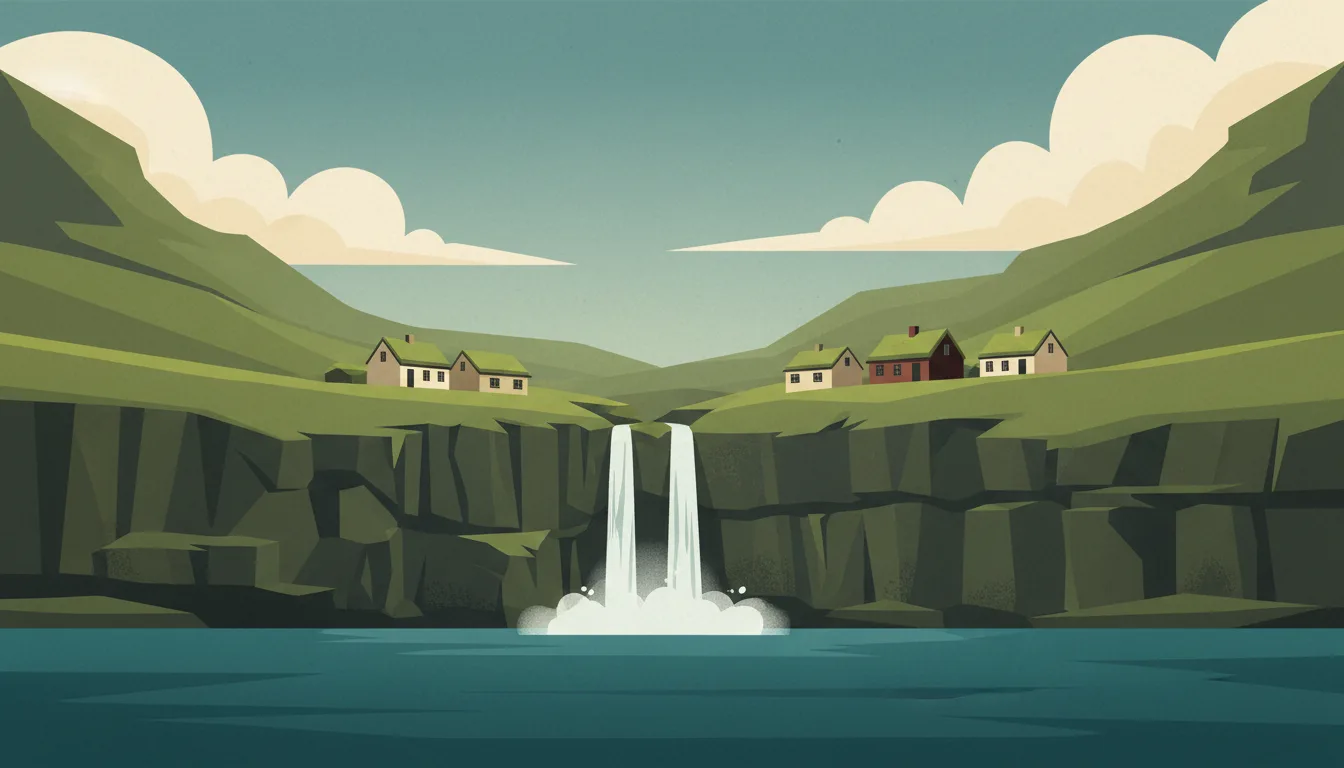
travel base1–2 daysMúlafossur at Gásadalur and the lake that appears to hang above the ocean at Trælanípa are a short drive from the airport. Sørvágur is the Mykines ferry port and the island holds the airport hotels.
Best time: May–September
Explore Vágar: Gásadalur & Sørvágsvatn - 03
Eysturoy: Gjógv & Eiði
North Atlantic
travel base1–2 daysGjógv's natural harbour gorge, the Risin og Kellingin sea stacks off Eiði and Slættaratindur, the highest mountain, sit in the north of the second-largest island, now linked to Tórshavn by the sub-sea Eysturoy tunnel.
Best time: May–September
Explore Eysturoy: Gjógv & Eiði - 04
Northern isles: Klaksvík & Viðoy
North Atlantic
travel base1–2 daysKlaksvík is the second town and fishing capital; tunnels reach Viðareiði on Viðoy beneath Cape Enniberg, one of Europe's highest sea cliffs, and Kunoy and Kalsoy with its Kallur lighthouse walk.
Best time: May–September
Explore Northern isles: Klaksvík & Viðoy - 05
Sandoy & Suðuroy
North Atlantic
travel base2 daysSandoy, now joined by the 2023 sub-sea tunnel, has dunes and gentle walks; Suðuroy is a two-hour ferry to a distinct island of coal mines, west-coast cliffs at Beinisvørð and the villages of Tvøroyri and Vágur.
Best time: May–September
Explore Sandoy & Suðuroy - 06
Mykines
North Atlantic
travel base1 dayThe westernmost inhabited island has one village, a lighthouse walk across a footbridge and dense puffin and gannet colonies from May to August. Access is by seasonal ferry or helicopter and a permit fee applies.
Best time: May–September
Explore Mykines
Things to do
What should you do in Faroe Islands?
Not a bucket list — the handful of things that make this country this country, with the timing catch that stops people doing them well.
- 01
Walk to the Mykines lighthouse
Mykines and Mykineshólmur
Puffins line the path in summer; the hike is fee-based and guided in peak season to protect the burrows.
- 02
Stand above Sørvágsvatn
Trælanípa, Vágar
The optical illusion of a lake perched above the Atlantic is a ninety-minute return walk on a paid landowner path.
- 03
Drive the sub-sea roundabout
Eysturoy tunnel
The 2020 tunnel between Streymoy and Eysturoy has the world's only undersea roundabout, lit by an art installation.
- 04
Hike to Kallur lighthouse
Kalsoy
A ferry from Klaksvík and a short exposed walk lead to the ridge that framed a James Bond finale.
- 05
See Tinganes and the Nordic House
Tórshavn
One of the oldest parliament sites in the world shares a town with a modern Nordic cultural centre.
- 06
Take the Vestmanna boat
Vestmanna, Streymoy
Sea-cliff boat tours pass through grottos beneath nesting birds when the swell allows.
How to get around
How do you get around Faroe Islands?
A hire car from Vágar airport is the practical way to see the islands: bridges and tunnels link Vágar, Streymoy, Eysturoy, Borðoy, Viðoy, Kunoy and now Sandoy. Ferries serve Suðuroy, Kalsoy, Mykines and the small islands, the subsidised Atlantic Airways helicopter reaches outer settlements, and the free red Tórshavn buses cover the capital.
Hire car through the tunnels
Distances are short but tunnels are tolled by number-plate recognition; the Eysturoy and Sandoy sub-sea tunnels are billed to the hire company. Book early for summer.
Rule of thumb: Any island with a road link → hire car.
Strandfaraskip Landsins ferries
The Smyril ferry from Tórshavn to Suðuroy takes two hours; small boats serve Kalsoy from Klaksvík and Mykines from Sørvágur in summer, all weather-dependent.
Bygdaleiðir island buses
Blue intercity buses link Tórshavn, Klaksvík, Vágar airport and larger villages several times a day; Tórshavn's red city buses are free.
Atlantic Airways helicopter
The subsidised helicopter loops to Mykines, Skúvoy, Svínoy and other outer islands on set days; residents have priority and seats open to visitors close to departure.
Passes and cards, honestly
- There is no transport pass; tunnel tolls are charged to the car and ferries are paid per crossing or via a Suðuroy return.
- Mykines requires a landing permit and hiking fee bought online; the lighthouse path is guided-only in peak season.
Travel tips
What should you know before you go?
The things locals assume you know. Most travellers learn them by getting one wrong on day two.
- A nation within the Danish realm
- The Faroes govern themselves in most matters, keep their own language, flag and football team and stayed outside the EU; Danish citizenship and defence remain shared.
- The grindadráp is contested
- The community pilot-whale hunt is legal, regulated and defended locally as subsistence; decide before travelling how you will engage with it rather than debating it with hosts.
- Chain dance and ballads
- Faroese kvæði, sung in a circle with linked arms, preserved the language for centuries; Ólavsøka is the moment to see it in public.
- Fermentation is the cuisine
- Ræst (wind-dried, fermented lamb and fish), skerpikjøt and dried whale were survival foods and now underpin New Nordic restaurants such as KOKS's successors.
- Land is private and paths are shared
- Many trails cross farms; pay the posted fees, close gates, stay off nesting cliffs and never walk on the turf roofs.
Travel basics
Visa, money, SIM cards and more
The boring section, which is why it is the one people skip and then regret at the airport.
visa
Danish realm, outside Schengen
The Faroes are part of the Kingdom of Denmark but not the EU or the Schengen Area. Nordic, EU and EEA citizens and most visa-waiver nationals enter with a passport; anyone who needs a Schengen visa must have it issued with explicit validity for the Faroe Islands via a Danish mission.
money
Danish krone at par
The currency is the Danish krone; the Faroes print their own króna banknotes at one-to-one with Danish notes and use Danish coins. Cards work everywhere, and Faroese notes are best spent before leaving as Danish banks exchange them reluctantly.
connectivity
Strong signal, no EU roaming
Føroya Tele covers almost every village and tunnel, but the islands sit outside EU roaming rules; buy a local tourist SIM or eSIM at the airport or use accommodation Wi-Fi.
plugs
Type C and K sockets
Danish-style 230 V sockets; standard European two-pin plugs fit, UK and North American visitors need an adapter.
safety
Weather, cliffs and one-lane tunnels
Crime is negligible. Fog and wind change in minutes, cliff edges are unfenced and turf is slippery; older single-lane tunnels have passing bays with strict priority rules, and sheep on roads are constant.
health
Good hospital in Tórshavn
The National Hospital covers the islands with helicopter evacuation from outer villages; EU EHIC cards are accepted for emergency care, but travel insurance for cancelled flights and boats matters more.
Trip costs
How much does a trip to Faroe Islands cost?
A mid-range trip usually needs about €120–€260 per person per day, before long-haul flights. Costs match Norway: hotels and guesthouses are scarce and expensive in summer, restaurants are pricey and fuel and ferries add up. Self-catering apartments, supermarket meals and a shared hire car keep a week within reach, while helicopters are subsidised and surprisingly cheap when seats are available.
Shoestring
€€80–120
per person / day
- Stay
- Hostel, campsite or shared guesthouse
- Food
- Supermarket and bakery meals
- Transport
- Buses, ferries and the subsidised helicopter
Feasible in Tórshavn with the public bus; reaching outer villages without a car takes patience.
Mid-range
€€120–260
per person / day
- Stay
- Guesthouse or self-catering apartment
- Food
- Café lunches and one good dinner
- Transport
- Shared hire car plus ferries
The practical level for a week of island-hopping.
Comfortable
€€300–550
per person / day
- Stay
- Hotel Føroyar or a design hotel in Tórshavn
- Food
- Tasting menus and heimablídni home dinners
- Transport
- Private guide, boats and helicopter seats
Spend on guided boat days and the Mykines margin rather than on rooms.
Sample itineraries
Starting points, not scripts
Each of these is a real request you could hand to Menta as written. Change the people, the month and the pace; the structure will hold.
Core islands from Tórshavn
5 days- Tórshavn
- Vágar
- Gjógv
- Klaksvík
- Saksun
A single base with day drives to the western lake, the Eysturoy gorge village and the northern fjord town, keeping one spare day for weather.
Puffins and the north
7 days- Sørvágur
- Mykines
- Tórshavn
- Eysturoy
- Kalsoy
- Klaksvík
Two Vágar nights positioned for a Mykines boat with a backup day, then the northern isles including the Kallur lighthouse walk.
All the way south
8 days- Tórshavn
- Vágar
- Eysturoy
- Klaksvík
- Sandoy
- Suðuroy
The complete tour adding the new Sandoy tunnel and two nights on Suðuroy via the Smyril ferry.
Common questions
Quick answers about travel in Faroe Islands
Short answers to the questions people ask before they book. Use the full guide for the detail and trade-offs.
- When is the best time to visit Faroe Islands?
- Late May–August for long light, puffins and open ferries; September for storms and fewer visitors. The Faroes have a cool oceanic climate with no dry month and little temperature range. Summer highs rarely pass fifteen degrees but days are twenty hours long, puffins nest on Mykines and all ferries run. Winter is dark, stormy and mild, with Atlantic depressions cancelling flights and boats; it suits storm-watching and Tórshavn culture, not island-hopping.
- How much does a trip to Faroe Islands cost?
- Plan about €120–€260 per person per day for a mid-range trip, before long-haul flights. Costs match Norway: hotels and guesthouses are scarce and expensive in summer, restaurants are pricey and fuel and ferries add up. Self-catering apartments, supermarket meals and a shared hire car keep a week within reach, while helicopters are subsidised and surprisingly cheap when seats are available.
- How do you get around Faroe Islands?
- A hire car from Vágar airport is the practical way to see the islands: bridges and tunnels link Vágar, Streymoy, Eysturoy, Borðoy, Viðoy, Kunoy and now Sandoy. Ferries serve Suðuroy, Kalsoy, Mykines and the small islands, the subsidised Atlantic Airways helicopter reaches outer settlements, and the free red Tórshavn buses cover the capital.
More destinations
Where else?
- JapanA megacity, a thousand temples and trains that leave to the second.
- ChinaImperial capitals, fast trains, regional tables and landscapes at continental scale.
- ItalyThree civilisations' worth of cities, and lunch takes two hours.
- SpainEurope's longest high-speed rail, five cultures, and lunch at three.
- PortugalTwo hilly cities, a valley of port and a long Atlantic coast.
- GreeceAntiquity, two hundred inhabited islands and a ferry timetable to respect.
- IcelandOne road, no trains, and weather that rewrites the plan daily.
- ThailandStreet food, temples, two coasts and Asia's cheapest good hotel room.
- VietnamTwo capitals, one slow railway and the best street food in Asia.
- MoroccoMedinas, the High Atlas and the Sahara, a ferry ride from Europe.
- MexicoA 3,000-year-old civilisation, the best street food on earth, and two coastlines.
- Costa RicaCloud forest, two coasts, volcanoes and wildlife best seen slowly.
- The BahamasShallow banks, island towns and water-led journeys between cays.
- BarbadosCoral coasts, Bajan food and an island with several speeds.
- CubaLayered cities, karst valleys and a journey that needs patience.
- Dominican RepublicCaribbean cities, mountain interiors and coasts beyond the resort gate.
- JamaicaMusic, mountain rain, strong food and coasts with different rhythms.
- FranceGreat cities, long lunches, mountains and a coast for every mood.
- United KingdomHistoric cities, wild coastlines and weather worth planning around.
- GermanyBig culture, small cities, forests and trains with caveats.
- NetherlandsCanals, art, cycling and small cities that reward staying longer.
- CroatiaAdriatic islands, stone towns, clear water and a crowded August.
- TurkeyMosques, markets, ancient cities and coastlines on a huge scale.
- SwitzerlandAlps, lakes and trains that make the expensive route feel simple.
- AustriaImperial cities, Alpine lakes, music and excellent rail links.
- NorwayFjords, midnight light, coastal towns and beautiful long distances.
- SwedenArchipelagoes, forests, design and summer light that lasts.
- FinlandLakes, saunas, forests and a capital built for slow days.
- CzechiaBeautiful old towns, serious beer and an easy train route beyond Prague.
- PolandDeep history, lively cities, forests, lakes and mountain food.
- IrelandAtlantic cliffs, music-filled towns, green roads and weather in charge.
- AustraliaBig distances, old landscapes, city beaches and wildlife in the wild.
- New ZealandVolcanoes, fjords, coast roads and a country made for the outdoors.
- IndonesiaVolcanoes, rice fields, reefs and thousands of islands to choose from.
- South KoreaFast cities, quiet temples, mountain trails and food at every hour.
- United StatesHuge landscapes, distinct cities and a route that must respect the map.
- CanadaBig wilderness, thoughtful cities and distances that need their own plan.
- ArgentinaBig-city appetite, Andean wine country and Patagonia at full scale.
- BrazilAtlantic cities, living cultures and continental-scale nature.
- ChileDesert sky, Pacific cities, volcano lakes and Patagonian wind.
- ColombiaHighland cities, Caribbean history and coffee-country roads.
- PeruAndean cities, living food cultures and Amazon headwaters.
- IndiaMughal cities, desert forts, sacred rivers and a monsoon coast.
- Sri LankaTea hills, ancient cities and two coasts with opposite seasons.
- NepalHimalayan trails, Newar cities and lowland jungle in one country.
- MalaysiaHawker cities, tea hills, island coasts and Bornean rainforest.
- PhilippinesIsland archipelago where the flight map decides the trip.
- CambodiaAngkor's stone, the Mekong's rhythm and a country still healing.
- TaiwanNight markets, high-speed rail and a mountainous Pacific island.
- LaosSlow Mekong days, mountain roads and a new railway.
- United Arab EmiratesSeven emirates, two big cities and a mountain-and-desert hinterland.
- JordanPetra, Wadi Rum and the Dead Sea on one compact road.
- OmanForts, wadis, dunes and turtle beaches on the Arabian Sea.
- EgyptThe Nile corridor, Red Sea reefs and five thousand years in sequence.
- South AfricaTwo oceans, self-drive safari and cities with unfinished histories.
- KenyaSavannah, highlands and a Swahili coast, sequenced by rain.
- TanzaniaThe northern circuit, Kilimanjaro and Zanzibar, priced honestly.
- NamibiaSelf-drive desert, empty roads and Africa's darkest skies.
- BelgiumFlemish art cities, Brussels institutions and forested Ardennes valleys.
- DenmarkCopenhagen design, island villages and long Jutland beaches.
- HungaryThermal baths, Danube grandeur, wine hills and the Great Plain.
- SloveniaAlpine lakes, an emerald river, karst caves and a Venetian coast.
- GeorgiaCaucasus villages, eight-thousand-year wine and a serious table.
- MontenegroA fjord-like bay, limestone peaks and a short, crowded coast.
- AlbaniaOttoman towns, an Ionian riviera and a raw alpine north.
- RomaniaSaxon towns, Carpathian wilderness and Europe's largest wetland.
- BulgariaMonasteries, mountain villages and a working Black Sea coast.
- SlovakiaAlpine peaks, castle ruins and wooden churches on a rail spine.
- Bosnia and HerzegovinaOttoman bazaars, stone bridges and wild rivers between mountains.
- EstoniaMedieval Tallinn, bog boardwalks, island manors and long white nights.
- LatviaArt Nouveau Riga, castle valleys, a wooden spa coast and deep forest.
- LithuaniaBaroque Vilnius, a dune spit, lake castles and pine spa towns.
- MaltaLimestone capital, Neolithic temples, harbour ferries and Gozo's slow coast.
- CyprusDivided capital, mosaic coast, painted mountain churches and a wild peninsula.
- SingaporeA dense, humid city-state that rewards districts, not landmarks.
- MaldivesAtolls, reefs and two very different ways to stay.
- BhutanHimalayan valleys, dzongs and a daily fee that shapes everything.
- UzbekistanSilk Road cities linked by fast trains and desert roads.
- EthiopiaRock churches, highland monasteries and a distinct calendar.
- UgandaGorillas, chimpanzees, the Nile and crater-lake forests.
- RwandaGorilla volcanoes, tea hills and a compact, orderly country.
- BotswanaDelta floods, elephant rivers and empty Kalahari pans.
- ZambiaWalking safaris, wild rivers and the Zambian side of Victoria Falls.
- MadagascarLemurs, baobabs and an island that evolved apart.
- MauritiusLagoon coasts, a volcanic interior and a Creole, Indian and Chinese island.
- TunisiaCarthage, medinas, Roman arenas and the Saharan oases.
- GuatemalaMaya highlands, volcano lakes and a Petén forest of ruins.
- PanamaCanal city, Caribbean archipelagos and cloud-forest coffee.
- EcuadorVolcano avenue, cloud forest, Amazon edge and the Galápagos.
- BoliviaAltiplano salt, Aymara cities and a wide Amazon lowland.
- UruguayCalm capital, Atlantic beaches and slow wine country.
- FijiReef islands, village life and two big green mainlands.
- SerbiaDanube cities, monastery hills and long-table hospitality.
- North MacedoniaOhrid's lake, Ottoman bazaars and mountain villages in a small compass.
- KosovoEurope's youngest country: café capital, Ottoman Prizren and alpine valleys.
- MoldovaUnderground wine cities, cliff monasteries and Europe's least-visited country.
- ArmeniaStone monasteries, Ararat views and a capital that stays up late.
- AzerbaijanCaspian capital, mud volcanoes and Caucasus villages above the tea plains.
- LuxembourgFortress capital, Moselle wine and Ardennes castles by free bus.
- AndorraPyrenean principality of ski valleys, Romanesque chapels and thermal spas.
- GreenlandIcebergs, ice sheet and Inuit towns reached only by air and sea.
- KazakhstanTian Shan foothills, steppe capital and canyon country by air.
- KyrgyzstanYurt stays, alpine lakes and horse treks in the Tian Shan.
- TajikistanPamir Highway, Wakhan villages and turquoise Fann lakes.
- PakistanMughal Lahore and the Karakoram, planned region by region.
- BangladeshRiver delta, mangrove tigers, tea gardens and Dhaka's old city.
- Hong KongVertical harbour city, outlying islands and surprising country parks.
- BruneiWater village, gilded mosques and untouched Borneo rainforest.
- Timor-LesteReef walls, mountain villages and a young nation's coastline.
- Saudi ArabiaNabataean tombs, Red Sea reefs and a fast-changing kingdom.
- QatarA compact Gulf peninsula built around one polished capital.
- GhanaAtlantic forts, Ashanti heritage and a warm, workable West Africa.
- SenegalDakar's music, Gorée's memory and delta and river landscapes.
- Cape VerdeTen Atlantic islands of morna, volcanoes and trade winds.
- SeychellesGranite islands, coral atolls and Creole ease in the Indian Ocean.
- MozambiqueIndian Ocean coast, dhow islands and a restored savanna.
- ZimbabweVictoria Falls, walking safaris and Africa's largest ancient stone city.
- MalawiA freshwater sea, restored parks and high plateaus in one small country.
- EswatiniA small kingdom of royal ceremony, rhino reserves and highveld hikes.
- LesothoThe mountain kingdom: pony treks, high passes and Basotho villages.
- BelizeBarrier reef, Maya cities and Garifuna coast in one small country.
- HondurasBay Islands diving, Copán's carved city and cloud-forest highlands.
- El SalvadorSurf coast, volcano towns and a small country in rapid change.
- NicaraguaColonial cities, twin-volcano island and two very different coasts.
- Trinidad and TobagoCarnival, ibis and doubles on Trinidad; reef and calm on Tobago.
- Saint LuciaThe Pitons, rainforest ridges and Kwéyòl villages on one green island.
- ParaguayRiver cities, Jesuit ruins and the enormous quiet of the Chaco.
- SamoaTwo volcanic islands, village fales and fa'a Samoa on its own terms.
- TongaA Polynesian kingdom of four island groups, whales and strict Sundays.
- VanuatuActive volcanoes, kastom villages and eighty islands of Melanesia.
- Cook IslandsRarotonga's ring road, Aitutaki's lagoon and atolls nobody reaches.









Faroe Islands is a good trip. Make it your trip.
Everything on this page is context Menta already has. Add the people going, the dates and what you actually care about, and the plan starts smarter than a blank chat.
Two journeys free. No payment details. 0 % markup on bookings.
Start planning Faroe IslandsGuide last reviewed 2026-09. Check visa rules against your own passport before you book.